
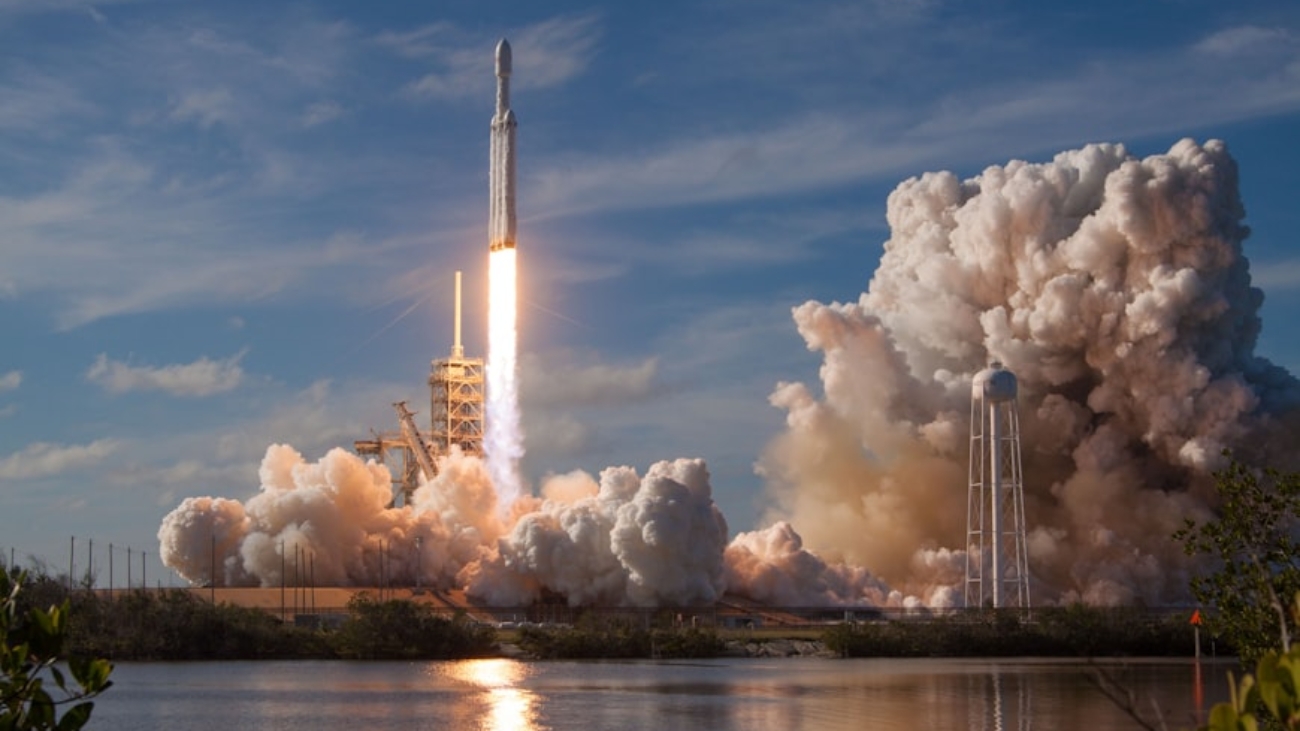
Kerala holds a uniquely strategic position in India’s space research and satellite development landscape. From the founding of Thumba Equatorial Rocket Launching Station (TERLS) in Thiruvananthapuram in 1963 to today’s advanced facilities at VSSC, LPSC, IISU, and various research labs, Kerala remains the intellectual and operational cradle of India’s space program. The state hosts ISRO’s core engineering minds, propulsion labs, material science excellence, and mission planning teams. As India enters a new era of space competition—private spaceflight, lunar exploration, interplanetary missions, satellite constellations, defence-driven space capabilities, and global commercial launch services—Kerala’s role can expand dramatically.
Kerala Vision 2047 must treat space research not merely as a scientific endeavour but as a strategic economic, educational, and geopolitical asset. By 2047, Kerala can become one of the world’s leading space-science clusters—an ecosystem where research institutions, manufacturing companies, software developers, universities, startups, and military-civilian agencies collaborate to advance India’s space ambitions.
A foundational element of Kerala’s strategic relevance is geography. Thumba’s proximity to the magnetic equator provides unique advantages for launching sounding rockets and conducting atmospheric studies. This makes Kerala an irreplaceable location for equatorial experiments. Vision 2047 must expand Kerala’s atmospheric and ionospheric research capabilities through new facilities for studying climate patterns, solar winds, space weather, and high-altitude radiation. These domains are critical for satellite reliability, defence systems, and communication technologies.
Thiruvananthapuram must evolve into a full-fledged Space Innovation Capital. Beyond the existing ISRO ecosystems, Kerala can create a dedicated Space Tech City—an integrated district with research parks, testing facilities, simulation labs, robotics bays, vacuum chambers, AI-based mission analytics centres, and private manufacturing units. This would transform the region into a multi-agency space cluster, similar to Silicon Valley’s tech network or France’s Toulouse Aerospace Valley. Such a cluster can attract global companies, international collaborations, and private investment.
Education is central to Kerala’s space future. Kerala’s engineering talent is strong, yet only a small fraction enters aerospace fields. Vision 2047 must expand aerospace engineering programmes across universities—including specialised fields like propulsion engineering, orbital mechanics, satellite communication, space robotics, astrophysics, materials science, and rocket manufacturing. New space research chairs, joint PhD programmes, and ISRO-affiliated academic wings can deepen these capabilities. School-level space clubs must be strengthened to inspire early interest; Kerala’s young minds must see space as both achievable and meaningful.
Kerala can also become the training ground for India’s future astronauts, mission planners, and satellite engineers. A Space Leadership Academy can be established to provide advanced training in mission design, systems engineering, planetary science, and human spaceflight preparation. This academy can serve not only India but also friendly nations seeking training partnerships. By 2047, Kerala can host Asia’s premier civilian space-training centre.
A powerful opportunity lies in harnessing Kerala’s IT sector for space applications. Space missions today rely heavily on AI, big data analytics, cybersecurity, navigation algorithms, image processing, and digital twinning. Technopark and Infopark can incubate startups focused on satellite imaging, weather prediction, autonomous navigation software, space debris tracking, and Earth observation analytics. These industries have enormous commercial potential. Many countries outsource their space data processing, and Kerala can serve as a global hub for space-software services.
Space manufacturing is another frontier. With India aiming to expand PSLV, SSLV, GSLV, and reusable launch systems, Kerala can specialise in high-precision components: navigation electronics, composite materials, cryogenic engine parts, onboard computers, sensors, solar panel units, and propulsion subsystems. Small industries can be trained and certified to join the space supply chain. A Space Industrial Corridor can be developed between Thiruvananthapuram and Kochi, linking aerospace academia with precision-engineering companies. This would create thousands of high-skilled jobs.
Kerala’s coastal location also enables new forms of space activity. As global space agencies explore sea-launch platforms—vessels capable of launching rockets from international waters—Kerala can become a logistics and support centre. Ports like Vizhinjam and Kochi can play roles in transporting heavy rocket components, supporting offshore launch infrastructure, or hosting ocean-based tracking systems. Kerala can also collaborate with the Navy for maritime surveillance of launch paths, creating an integrated defence–space partnership.
Climate change research is another area where Kerala can lead. With its unique landscape of coast, hills, backwaters, and forests, Kerala is an ideal natural laboratory for satellite-based climate studies. By 2047, Kerala can host one of the world’s largest Earth Observation Analysis Centres, tracking monsoons, land-use patterns, deforestation, fisheries, drought cycles, and disease vectors. These insights can support policy across agriculture, water management, disaster preparedness, and urban planning.
Kerala must also contribute to India’s planetary missions. Whether it is Chandrayaan, Mangalyaan, Venus missions, or asteroid studies, the state can provide propulsion technologies, scientific instruments, thermal shielding components, and mission testing infrastructure. University research groups in Kerala can specialise in planetary geology, space chemistry, low-gravity robotics, and mission simulation modelling. Joint labs with ISRO can ensure that Kerala becomes the birthplace of the next generation of planetary explorers.
Public participation can deepen Kerala’s space identity. Planetariums, space museums, rocket parks, VR mission simulators, and astronaut interaction programmes can be established across districts. Festivals similar to Kochi Biennale can be organised—this time celebrating science, astronomy, and space art. A society that celebrates science becomes a society that produces scientists.
Commercial space entrepreneurship must be nurtured. India’s private space sector is growing, and Kerala must position itself as a partner. Small startups can develop CubeSats, nanosatellite launch services, telemedicine space applications, ocean-monitoring payloads, and agricultural satellite data tools. Government incentives, incubators, testing access, and venture capital channels can accelerate the rise of Kerala-based space companies.
International collaboration is a strategic necessity. Kerala can host Indo-European space innovation summits, Indo-Japanese robotics workshops, Indo-UAE satellite-development programmes, and Indo-African remote-sensing training camps. Thiruvananthapuram can become a global meeting point for space scientists, engineers, and policy thinkers. By 2047, Kerala could host an annual international space conference equivalent to the world’s major aviation and space expos.
Finally, space research must be woven into Kerala’s identity. Space not only inspires scientific curiosity—it shapes how societies think about the future, resilience, unity, and human possibility. Making Kerala a central pillar of India’s space ambitions creates an aspirational culture where children grow up dreaming not just of engineering degrees but of missions to the Moon, Mars, or deep space.
By 2047, Kerala can stand as India’s Space State—a region where ancient intellectual traditions meet cutting-edge cosmic exploration; where universities, industries, ISRO labs, and startups collaborate seamlessly; where young minds see space science as a calling; and where the world recognises Kerala as a strategic partner in humanity’s journey beyond Earth.
A strong space ecosystem strengthens not only Kerala but India’s place in the emerging space century.
