
Alappuzha is Kerala’s most distinctive natural-fibre and backwater economy. Historically, it has been the global capital of coir, a major marine-processing district, a rice-bowl region, and one of India’s earliest planned towns. Yet its present economic output — estimated at ₹15,000–17,000 crore — underperforms its natural advantages. By 2047, Alappuzha can evolve into a ₹50,000–55,000 crore diversified district economy, powered by modernised coir manufacturing, value-added food processing, sustainable backwater tourism, logistics, inland waterway mobility, and precision agro-industries.
Coir must be the district’s centrepiece. Today, Alappuzha accounts for roughly 60 percent of Kerala’s coir production, with nearly 1,200 coir units and more than 1 lakh workers, yet most units operate with limited mechanisation and low global branding. Annual output is roughly ₹4,000–5,000 crore. By 2047, with automated spinning, loom modernisation, fibre grading sensors, geotextile R&D labs, and high-value product clusters, the coir sector can grow to ₹15,000 crore. Export value alone can rise from ₹1,300–1,500 crore today to ₹6,000 crore, especially in geotextiles, erosion-control mats, floor coverings and composite fibre materials. A fully integrated Coir Innovation Park in Cherthala or Alappuzha Central can anchor this transformation, attracting start-ups and engineering firms building new applications for coconut fibre.
Food processing offers the second major pillar for expansion. With strong fishing communities, rice cultivation, coconut farms and vegetable belts, Alappuzha has a diverse agricultural base, but value addition remains under 20 percent. The district currently generates ₹2,500–3,000 crore in food processing and marine products. By building modern fish-processing clusters in Arthunkal, Thottappally, and Purakkad — complete with cold-chain infrastructure, automated grading and international compliance — the district can reach ₹8,000–9,000 crore. Meanwhile, rice value chains from Kuttanad can contribute an additional ₹2,000–2,500 crore in ready-to-cook, nutritionally enriched and export-oriented rice products by 2047. Smart cold logistics can cut food wastage from nearly 12 percent today to 3 percent, improving both farmer incomes and export competitiveness.
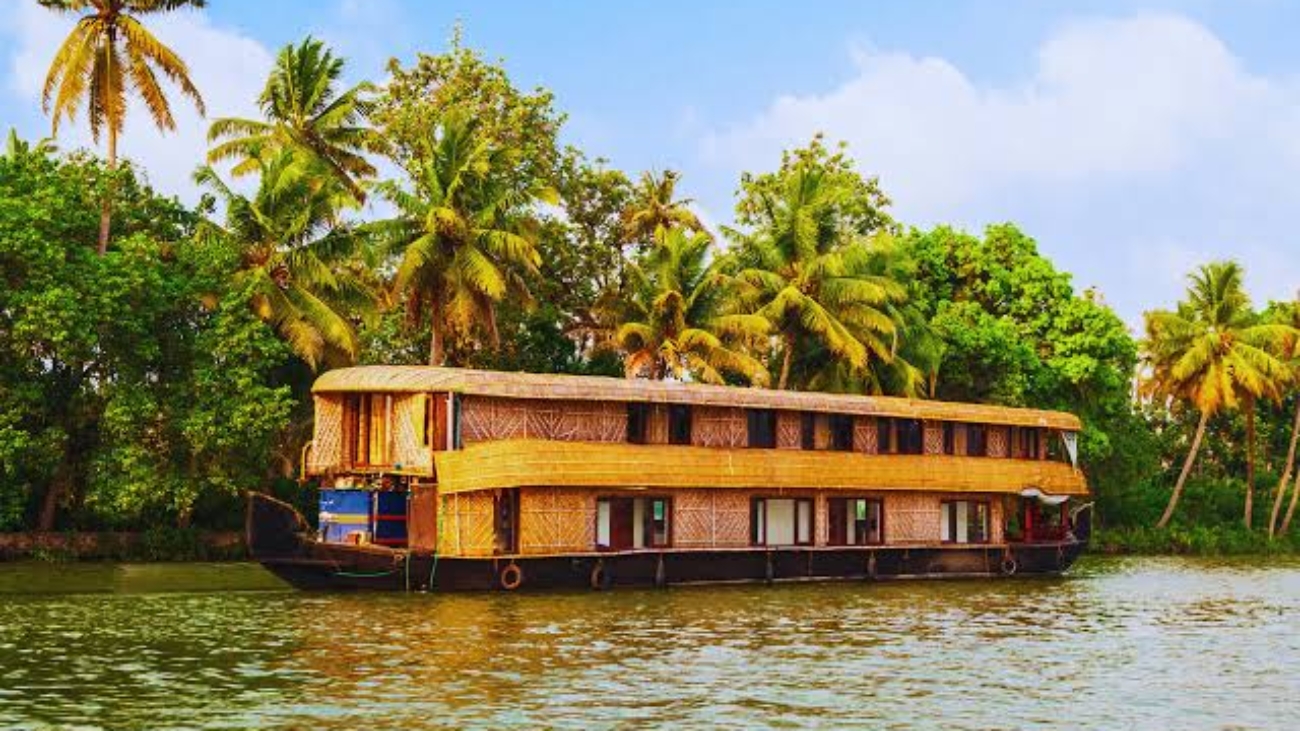
The third pillar is Alappuzha’s iconic backwater tourism. With the Vembanad Lake system, houseboats, heritage architecture and coir villages, the district attracts 20–25 lakh visitors annually, generating approximately ₹2,500–3,000 crore. However, inefficiencies in transport, inconsistent service quality, environmental pressures and seasonality reduce the sector’s true potential. Over the next two decades, Alappuzha can expand its tourism economy to ₹10,000–12,000 crore through digital ticketing, clean-energy houseboats, regulated backwater routes, blue-tourism circuits, water-sports clusters and eco-lodges across Kuttanad. Smart visitor management systems can increase per-tourist spending by 2–3 times, while distributed sewage treatment and lake health monitoring can preserve the ecology of Vembanad.
Modernisation of inland waterways is another essential growth driver. National Waterway 3 and the district’s natural canal system can become Kerala’s most efficient low-carbon logistics backbone by 2047. Today, inland-waterway cargo movement is negligible; with port linkages, intermodal terminals, and automated cargo-handling, Alappuzha can move 1.5–2 million tonnes annually through waterways, adding ₹1,500–2,000 crore to the circular economy. Passenger water-mobility systems can reduce road congestion, cut emissions and connect Cherthala, Alappuzha town, Punnapra, and Ambalappuzha with seamless water–road integration.
Agro-industrial growth depends on transforming Kuttanad into India’s most advanced wetland agro-tech zone. The region’s paddy output, nearly 2.5–3 lakh tonnes annually, can become the base for rice-protein extraction, fortified rice products, biofertilisers and precision-farming systems. With real-time water-level sensors, drone mapping, climate prediction and automated flood valves, Alappuzha can reduce crop-loss risk by 40 percent and lift paddy productivity by 20 percent. Combined with vegetable and coconut processing, agro-tech innovations can add ₹4,000–5,000 crore to the district economy by 2047.
Coastal resilience and environmental health will determine how sustainably Alappuzha grows. Vembanad has lost nearly 40 percent of its depth in parts due to siltation; houseboats generate waste pressure; and saline intrusion threatens Kuttanad agriculture. With digital lake-health dashboards, controlled dredging, decentralised sewage systems, and mangrove restoration, the district can reverse ecological degradation while expanding economic activity. An annual Vembanad Health Index — publicly released — can drive accountability and citizen engagement.
Human capital development is a structural requirement. Alappuzha needs 70,000–90,000 skilled workers across coir engineering, marine logistics, food processing, water tourism, and agro-technology. District skill hubs can link training directly to industry demand through digital apprenticeships, with placement tracking and productivity benchmarks. A specialised Coir Research & Design School can nurture global product designers working with natural fibres.
Logistics and mobility must evolve to match economic ambitions. Alappuzha requires four major industrial corridors — Cherthala zone, Alappuzha town cluster, Kuttanad agro-tech belt and Ambalappuzha–Haripad corridor — all equipped with real-time traffic sensors, smart freight parking and flood-proofed road infrastructure. A unified mobility command centre can cut travel time by 25 percent, benefiting manufacturing, tourism and agro supply chains.
If executed systematically with measurable KPIs, Alappuzha can achieve the following by 2047:
• Total economic output rising from ~₹17,000 crore to ₹50,000–55,000 crore.
• Coir sector expanding to ₹15,000 crore with ₹6,000 crore exports.
• Food & marine processing reaching ₹10,000–12,000 crore.
• Tourism generating ₹10,000–12,000 crore.
• Agro-tech value chains contributing ₹4,000–5,000 crore.
• Inland-waterway logistics adding ₹1,500–2,000 crore.
• Creation of 1–1.3 lakh new jobs.
Alappuzha’s future lies in blending natural-fibre innovation, agro-ecological intelligence, and blue-economy modernisation. Kerala Vision 2047 demands that the district evolve into a sustainable, export-ready, technologically enriched backwater–industrial economy — one that respects its ecological foundations while unlocking unprecedented economic potential.
