
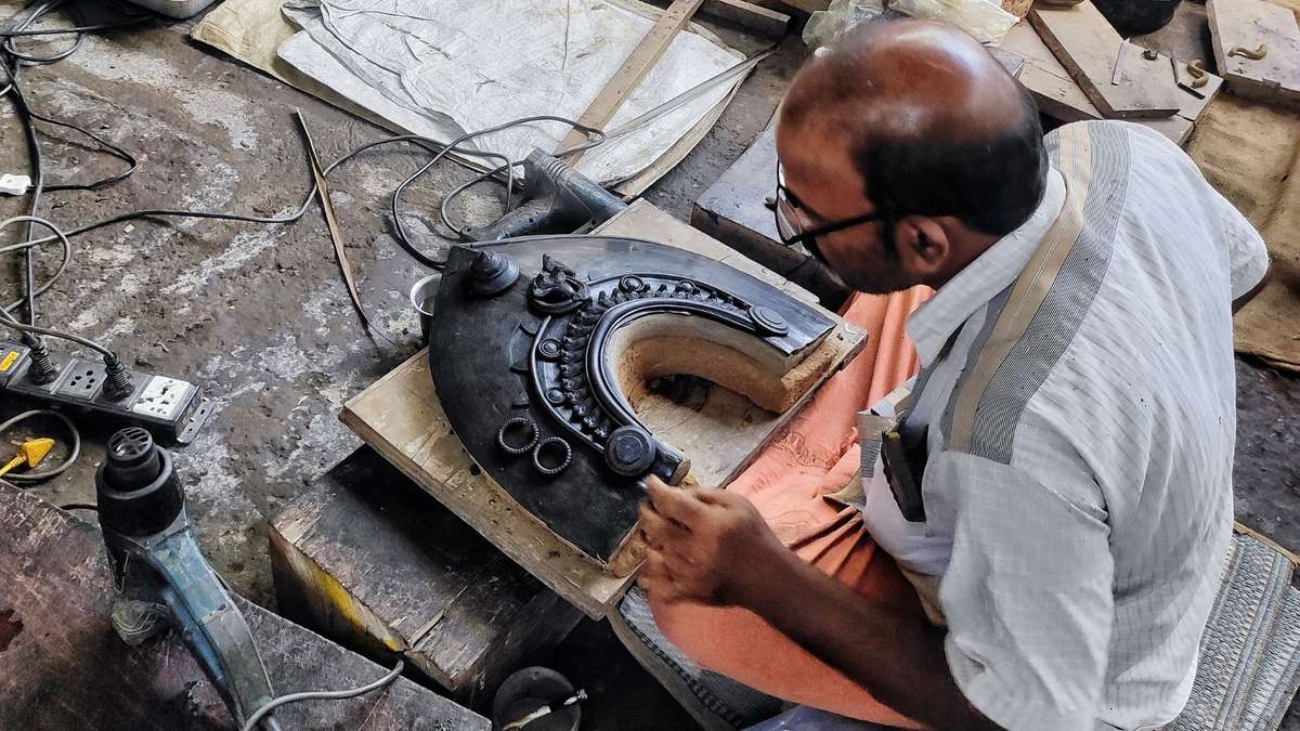
By 2047, Kerala must demonstrate that traditional artisanal communities can move from physical marginality to technological centrality without losing identity or dignity. For small-population OBC groups whose traditional trades are manual, skilled, and craft-based, the future does not lie in abandoning heritage nor in freezing it in nostalgia. Kerala Vision 2047 proposes a tech-enabled empowerment pathway for the Moosari community, a low-population OBC group traditionally associated with metalwork—iron tools, agricultural implements, household utensils, ritual objects, and repair work. The objective is to convert a declining manual trade into a modern engineering–craft small business ecosystem rooted in technology, precision, and market relevance.
The Moosari community’s challenge is not lack of skill, but collapse of context. Traditional demand for hand-forged tools, vessels, and implements has shrunk due to factory production, imports, and changing consumption patterns. Younger generations exit the trade because income is irregular, status is low, and work is physically demanding with little upside. Vision 2047 reframes this crisis as a design and systems failure, not a failure of the community. Metalwork has not disappeared; it has moved into engineered products, precision components, repair services, and customised fabrication. The Moosari community must be repositioned at this new interface.
The first pillar of empowerment is reclassifying the traditional trade as applied engineering fabrication. Moosari skills—heating, shaping, joining, tempering, and finishing metals—are foundational to modern fabrication. Vision 2047 introduces structured upskilling in welding technologies, CNC-assisted cutting, laser measurement, metallurgy basics, corrosion control, and safety engineering. The community’s traditional intuition about metals is augmented with digital tools, transforming blacksmiths into certified fabrication technicians and micro-engineers.
The second pillar is transitioning from individual workshops to registered micro-fabrication enterprises. Traditional Moosari work is often solitary or family-bound. Vision 2047 deliberately pushes a shift toward small firms employing five to fifteen people, equipped with shared machinery and digital design capability. These MSMEs do not compete with large factories but specialise in short-run, customised, repair-oriented, and location-specific fabrication that factories avoid. Ownership remains within the community, anchoring wealth and decision-making locally.
The third pillar is integration with construction, infrastructure, and public works supply chains. Kerala’s housing, public buildings, roads, water systems, and renewable energy installations require constant metal fabrication—grills, railings, brackets, frames, supports, housings, anchors, and retrofits. Vision 2047 creates procurement pathways that allow Moosari-owned fabrication MSMEs to become preferred local suppliers for panchayats, municipalities, PWD, housing boards, and utilities. This converts sporadic retail work into predictable contract-based employment.
The fourth pillar is repair, retrofit, and life-extension services as a core business model. Modern economies waste metal through premature replacement. Vision 2047 positions Moosari enterprises as specialists in repair and retrofit of gates, shutters, machinery parts, agricultural tools, industrial fixtures, and public infrastructure. Digital diagnostics, measurement tools, and documentation allow repair work to meet formal standards. This repair economy creates steady demand while aligning with sustainability goals.
The fifth pillar is digital design as an entry into higher value. Vision 2047 introduces CAD tools, parametric design software, and digital templating to Moosari workshops. Community youth trained in design translate client needs into precise drawings, reducing rework and enabling collaboration with architects, engineers, and contractors. This shifts Moosari enterprises from labour pricing to design-plus-fabrication pricing, significantly improving margins and professional status.
The sixth pillar is traditional craft repositioned into niche markets. Ritual objects, lamps, temple fittings, heritage restorations, and customised cultural artefacts still require skilled metalwork. Vision 2047 does not abandon this domain but upgrades it. Digital documentation, 3D scanning of legacy designs, and online catalogues allow Moosari artisans to access institutional, heritage, and export markets without middlemen. Tradition survives by becoming technically organised rather than informally transmitted.
The seventh pillar is women’s participation through technology layers. Traditional metal trades often excluded women due to physical demands and workshop culture. Vision 2047 opens new roles for Moosari women in design, quality control, inventory systems, client coordination, accounting, surface finishing, and digital marketing. Women-led micro-units can manage finishing, assembly, and documentation stages, integrating households into enterprise growth.
The eighth pillar is shared infrastructure and tool libraries. Individual MSMEs cannot afford advanced machinery or testing equipment. Vision 2047 establishes community fabrication hubs with shared CNC machines, plasma cutters, testing rigs, safety infrastructure, and digital workstations. These hubs employ technicians and managers while enabling dozens of Moosari enterprises to operate at higher technical standards without crippling debt.
The ninth pillar is financial formalisation without bureaucratic overload. Moosari enterprises often remain informal due to fear of compliance. Vision 2047 embeds digital accounting, GST support, payroll systems, and procurement compliance into shared service platforms. This allows enterprises to access bank credit, insurance, and government contracts while focusing on production rather than paperwork.
The tenth pillar is intergenerational continuity through enterprise, not obligation. Vision 2047 explicitly avoids trapping children into hereditary labour. Instead, children of Moosari families grow up seeing metalwork as a modern engineering business with digital tools, clients, and growth paths. Some may enter design, some operations, some management, some entirely different fields. What persists is capability and option, not compulsion.
The eleventh pillar is numbers-based impact realism. Even conservative projections show scale. If 2,000 Moosari youth statewide transition into certified fabrication roles, and 800 to 1,000 Moosari-owned MSMEs emerge over two decades, each employing an average of eight people, the community anchors 6,000 to 8,000 direct jobs. For a small-population OBC group, this level of employment density is transformational.
The final pillar is dignity through technical indispensability. In modern Kerala, respect increasingly follows those who keep systems functioning. When Moosari-owned enterprises fabricate structural supports, repair public assets, customise safety infrastructure, and solve site-specific engineering problems, social narratives shift. The community is no longer seen as a relic of the past, but as a technical backbone of everyday life.
By 2047, success will be visible in ordinary settings. Construction sites source locally fabricated components. Panchayats rely on nearby fabrication firms. Youth choose to stay because income is steady and work is skilled. Women participate in enterprise decisions. Traditional knowledge lives on, embedded inside digital tools rather than fading away.
This is the Kerala Vision 2047 for the Moosari community: a future where a small-population OBC group reclaims economic relevance by translating traditional metal craft into tech-enabled engineering enterprise—proving that the most durable form of heritage is one that adapts, scales, and earns its place in the modern economy.
