
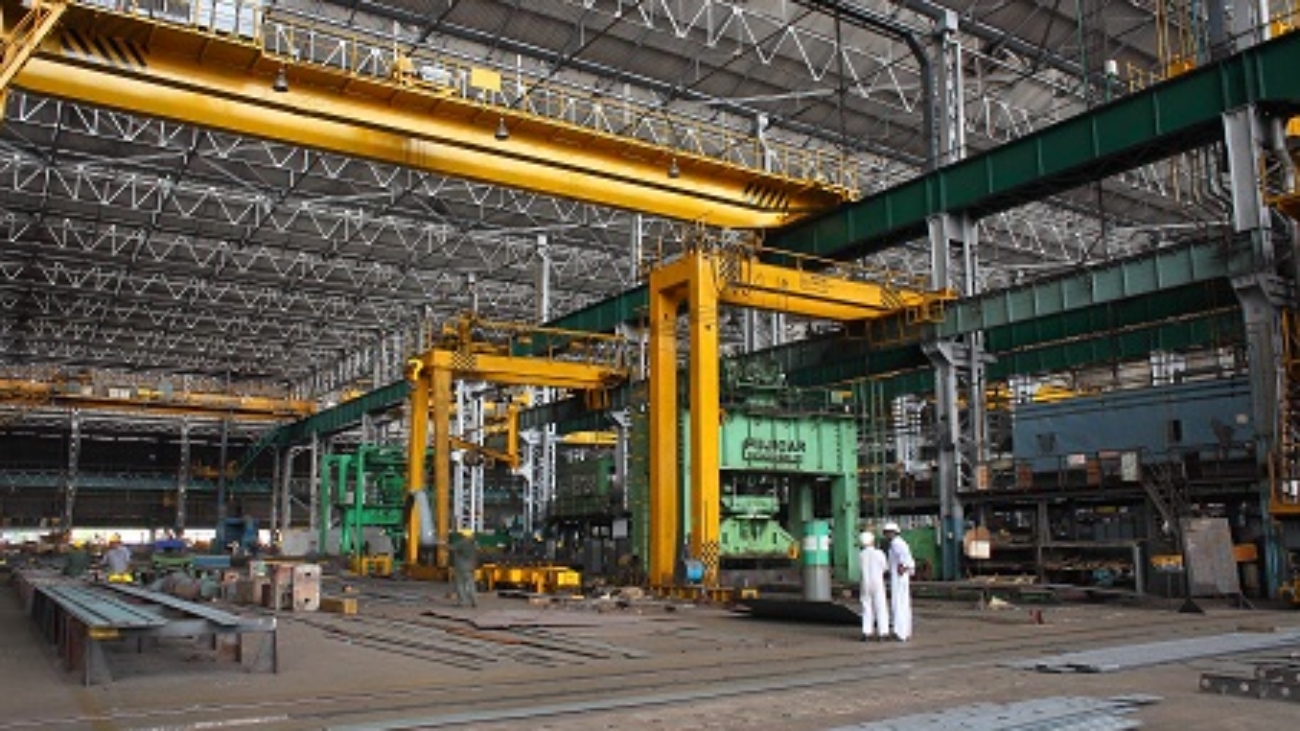
Kerala’s strongest concentration of large-scale, real-world mechanical engineering exists where metal, motion and seawater meet at industrial scale. Cochin Shipyard Limited represents this environment more clearly than any other organisation in the state. Located in Kochi and operating since the early 1970s, the shipyard is not just an industrial unit but a continuous mechanical engineering system in motion. Every day, heavy structures are fabricated, aligned, welded, lifted, machined and tested under demanding conditions. As Kerala looks toward 2047, the mechanical depth embedded in Cochin Shipyard remains one of its most strategic technical assets.
Mechanical engineering at Cochin Shipyard begins with scale. Ships are among the largest moving machines built by humans. Hull blocks weigh hundreds of tonnes. Dry docks extend hundreds of metres. Cranes handle loads that exceed what most industrial facilities ever encounter. Mechanical engineers work with structural members, lifting systems,TORIAL, load calculations, welding sequences and alignment plans where even small errors can cascade into large failures. Precision here is not optional; it is enforced by physics.
Shipbuilding is fundamentally a mechanical assembly problem executed in stages. Steel plates are cut, bent and welded into blocks. Blocks are assembled into sections. Sections are joined into hulls. Throughout this process, engineers manage thermal distortion, residual stress and dimensional accuracy. Welding generates heat that expands metal; cooling causes contraction. Mechanical engineers plan weld sequences and fixturing to control these effects, ensuring that final dimensions remain within tolerance over hundreds of metres.
Marine propulsion systems form another core mechanical domain. Main engines, gearboxes, shaft lines and propellers must operate smoothly under high loads for decades. Shaft alignment is measured in microns, not millimetres. Bearings must support rotating masses under constant vibration. Lubrication systems must function reliably even when ships roll and pitch at sea. Engineers test, monitor and recalibrate these systems repeatedly before vessels leave dock.
Repair and refit work often surpasses new construction in mechanical complexity. Vessels arrive with worn components, corrosion damage and legacy systems that must be integrated with modern upgrades. Mechanical engineers dismantle large assemblies, assess wear patterns, redesign interfaces and fabricate replacement parts. Many components are custom-built rather than off-the-shelf, requiring reverse engineering and adaptive design under time pressure.
Dry dock operations showcase mechanical coordination at its most intense. When a ship enters dry dock, water is drained and the vessel rests on precisely positioned keel blocks and side supports. Load distribution must be calculated accurately to avoid structural damage. Pumps, valves, gates and support systems operate in synchrony. Engineers monitor stresses throughout the docking process. Failure at this stage can result in catastrophic damage, making procedural discipline critical.
Heavy fabrication is a daily reality. Plate rolling, structural welding, pipe fabrication and pressure vessel work occur simultaneously across the yard. Mechanical engineers oversee material selection, weld procedures, non-destructive testing and quality assurance. Ultrasonic, radiographic and magnetic particle inspections are routine. These practices ensure structural integrity over service lives that may exceed 30 years.
Cranes and material handling systems represent another layer of mechanical complexity. Gantry cranes, jib cranes and mobile cranes operate continuously, lifting components weighing hundreds of tonnes. Mechanical engineers are responsible for maintenance of wire ropes, brakes, gear systems and structural elements. Failure here risks not only equipment but human life, making safety engineering central to operations.
Marine auxiliary systems further expand the mechanical scope. Pumps, compressors, heat exchangers, boilers and HVAC systems are installed and tested aboard vessels. Each system must function independently and as part of an integrated whole. Mechanical engineers manage piping layouts, vibration isolation, noise control and accessibility for maintenance. Space constraints aboard ships force compact and efficient designs.
The environmental conditions of Kochi add engineering challenges. High humidity accelerates corrosion. Salt air degrades coatings and fasteners. Engineers select materials, coatings and cathodic protection systems to extend asset life. Corrosion management is continuous, not periodic. Decisions made during fabrication directly affect maintenance burden years later.
Workforce scale amplifies impact. Thousands of engineers, technicians and skilled workers operate within the shipyard ecosystem. Knowledge is transferred through practice, not manuals alone. Apprentices learn by observing weld behaviour, machinery response and alignment adjustments. Over decades, this builds a tacit mechanical intelligence that cannot be easily replicated elsewhere.
Shipyard mechanical engineering is increasingly data-assisted. Vibration monitoring, alignment sensors and performance diagnostics are now standard. Condition-based maintenance replaces reactive repair. Engineers interpret data trends to predict failures before they occur. This integration of mechanical systems with analytics improves uptime and reduces lifecycle cost.
Cochin Shipyard’s role in defence adds another dimension. Naval vessels demand higher standards of survivability, redundancy and stealth. Mechanical systems must operate quietly, withstand shock loads and function under combat conditions. Design margins are conservative. Testing is rigorous. Engineers operate under protocols that prioritise reliability above cost or speed.
The export dimension of shipbuilding also matters. Vessels built or repaired at Kochi serve international clients. Mechanical quality directly affects global reputation. Each successful delivery reinforces trust in Kerala’s industrial capability. Over time, this trust converts into repeat business and long-term strategic relevance.
Looking toward 2047, shipbuilding itself is evolving. Hybrid propulsion, energy-efficient hull forms, automation and alternative fuels will reshape mechanical design. Yet the fundamentals remain unchanged. Steel must still be cut accurately. Shafts must still align. Structures must still carry load. Mechanical engineering remains the backbone of maritime capability.
There is also a spillover effect. Engineers trained at Cochin Shipyard move into power plants, heavy industry, offshore platforms and infrastructure projects across Kerala and beyond. The standards and discipline learned in shipbuilding elevate mechanical practice elsewhere. This diffusion of expertise strengthens the broader engineering ecosystem.
Despite its scale, shipyard work is rarely glamorous in public narratives. It is noisy, heavy and physically demanding. Yet it is here that engineering meets reality most directly. Forces are visible. Mistakes are unforgiving. Success is measured in decades of safe operation rather than immediate applause.
As Kerala shapes its vision for 2047, Cochin Shipyard stands as proof that advanced mechanical engineering is not theoretical or imported. It is built daily through disciplined execution, skilled labour and institutional continuity. In an era obsessed with digital abstraction, such grounded engineering capability is a strategic advantage.
Mechanical engineering will remain central to transport, defence, energy and infrastructure. Cochin Shipyard demonstrates that Kerala already possesses this depth. The challenge ahead is not to replace it, but to sustain, modernise and respect it.
