
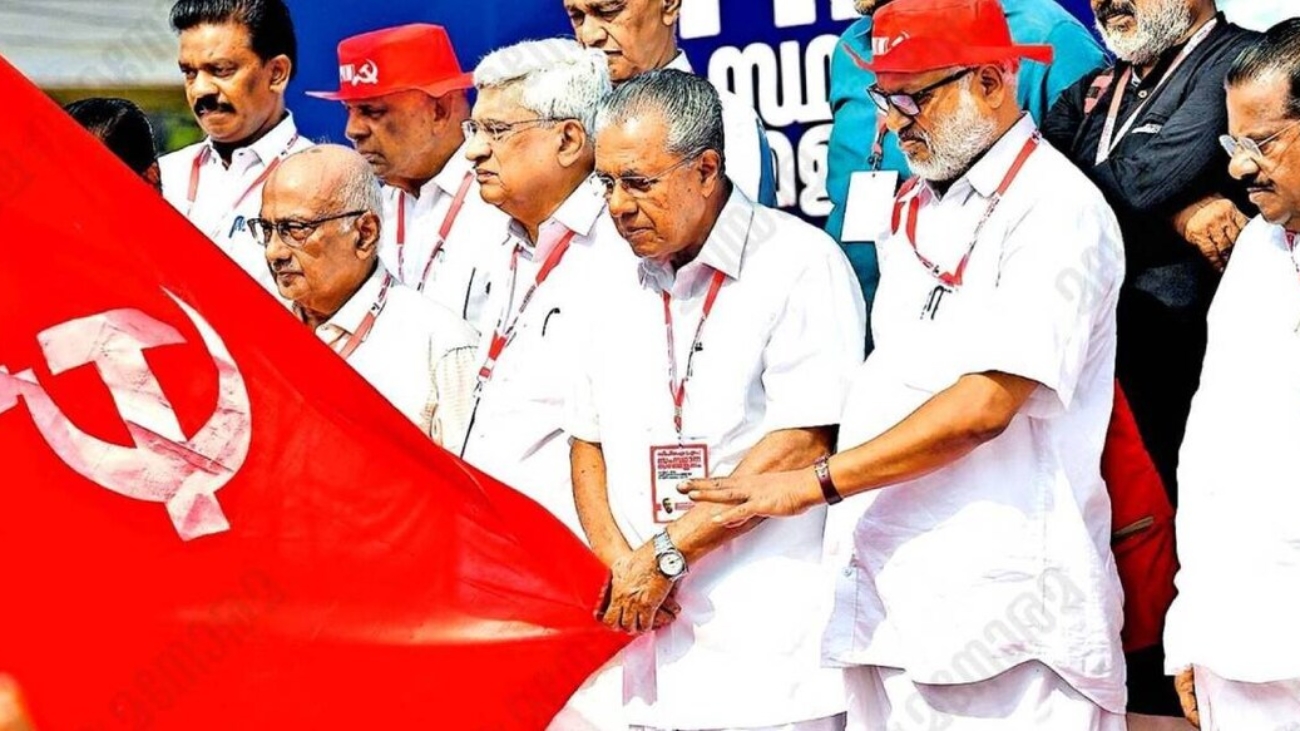
The governance record of the Communist Party of India (Marxist) in Kerala increasingly reveals a structural contradiction between ideological promise and administrative practice. While the party continues to speak in the language of transformation, equality, and systemic change, governance on the ground has become largely managerial, technocratic, and incremental. This gap does not indicate incompetence; rather, it reflects the constraints of operating within a globalised economy and a federal system. Yet the ideological implications of this shift remain insufficiently acknowledged, creating a quiet erosion of credibility.
In the early decades of Left governance, ideology and administration were closely aligned. Policy interventions such as land reform, education expansion, and labour protections directly reflected ideological commitments. The state acted as an agent of redistribution and restructuring. Governance itself was a political act, visibly altering power relations. Citizens experienced ideology not as abstraction but as lived change. This alignment created trust and legitimacy that endured across generations.
Over time, the scope for such transformative action narrowed. Kerala’s fiscal capacity became constrained by limited industrial growth, high welfare expenditure, and dependence on central transfers. Globalisation further restricted state autonomy. Capital mobility, trade regimes, and competitive federalism reduced the ability of any state government to radically alter economic structures without incurring significant costs. In this context, governance necessarily shifted from transformation to management.
Contemporary CPI(M)-led administrations operate within these constraints. Budgetary priorities focus on welfare delivery, infrastructure maintenance, disaster response, and incremental service improvement. Policy language increasingly mirrors that of development agencies and technocratic institutions, emphasising efficiency, targeting, and outcomes. While these are not undesirable, they sit uneasily alongside ideological claims of systemic change.
This contradiction becomes visible in economic policy. Despite ideological discomfort with private capital, governments actively court investment through IT parks, tourism promotion, startup incentives, and public–private partnerships. These initiatives acknowledge economic necessity, yet they are rarely framed within a coherent ideological reinterpretation. Instead, they are presented as pragmatic exceptions rather than principled evolution. Over time, pragmatism without articulation appears ad hoc rather than strategic.
Welfare policy offers another illustration. Kerala’s welfare architecture is extensive and effective by Indian standards. Pensions, subsidies, and social security schemes reach large segments of the population. However, welfare has become the primary site of political differentiation rather than a complement to productive transformation. Redistribution persists without a parallel narrative of value creation. This creates a politics of maintenance rather than movement, where the state manages outcomes rather than reshapes systems.
Administrative culture has also shifted. Governance increasingly relies on experts, consultants, data dashboards, and compliance frameworks. Decision-making is professionalised and centralised. While this improves execution, it distances governance from mass political participation. Party cadres, once deeply involved in implementation and mobilisation, now play a more symbolic role. Ideology remains within party structures, while administration moves along bureaucratic lines.
This bifurcation produces a subtle alienation. Citizens interact with the state primarily as service users rather than political participants. Their evaluation of government is based on delivery rather than direction. When ideology does not materially alter governance behaviour, it becomes secondary in public consciousness. The party may still claim ideological distinctiveness, but lived experience suggests convergence with other administrative regimes.
Crisis governance further highlights this shift. Kerala’s responses to floods, pandemics, and natural disasters have been widely praised for competence and coordination. These successes stem from institutional capacity, professional expertise, and decentralised administration rather than ideological mobilisation. While political leadership matters, the tools employed are managerial. Success reinforces trust in administration, not necessarily in ideology.
Electoral outcomes reflect this dynamic. Support for CPI(M) often correlates more strongly with governance performance and welfare delivery than with ideological alignment. Voters reward competence but feel less compelled to internalise ideological narratives. This transactional relationship stabilises power in the short term but weakens ideological reproduction in the long term.
Internally, this tension creates strain. Cadres trained in ideological frameworks struggle to reconcile daily governance compromises with doctrinal purity. Younger party members, exposed to global ideas and professional norms, often prioritise administrative effectiveness over ideological consistency. Without explicit ideological recalibration, these tensions remain unresolved, expressed quietly through disengagement rather than debate.
Globally, Left movements that confronted similar contradictions either redefined ideology to include governance realism or accepted ideological dilution in exchange for administrative relevance. In Kerala, this reckoning remains incomplete. Ideology is preserved rhetorically, while governance evolves pragmatically. The distance between the two widens slowly but steadily.
The deeper risk is not policy failure but narrative vacuum. When ideology no longer explains governance choices, politics becomes reactive. Decisions are justified case by case rather than situated within a coherent future vision. Opponents then frame debates, while the Left responds defensively. Over time, agenda-setting power shifts away from those who govern.
Kerala’s future challenges will intensify this pressure. Fiscal stress from ageing demographics, climate adaptation costs, healthcare expenditure, and shrinking workforce participation will demand hard trade-offs. Managing these choices requires not only technical skill but moral framing. Without an updated ideological language that acknowledges constraints while articulating purpose, governance risks being perceived as necessary but uninspiring.
This does not imply abandoning ideological commitment. Rather, it calls for honest reconciliation between ideals and instruments. Transformative politics in the twenty-first century may not resemble mid-twentieth-century models, but transformation remains possible through institutional redesign, productivity enhancement, and inclusive growth strategies. Naming this shift explicitly is essential for credibility.
The historical strength of CPI(M) in Kerala lay in its capacity to align moral vision with material action. As governance becomes more complex, that alignment must be consciously rebuilt rather than assumed. Otherwise, ideology survives as memory, governance continues as management, and the space between them quietly expands.
