
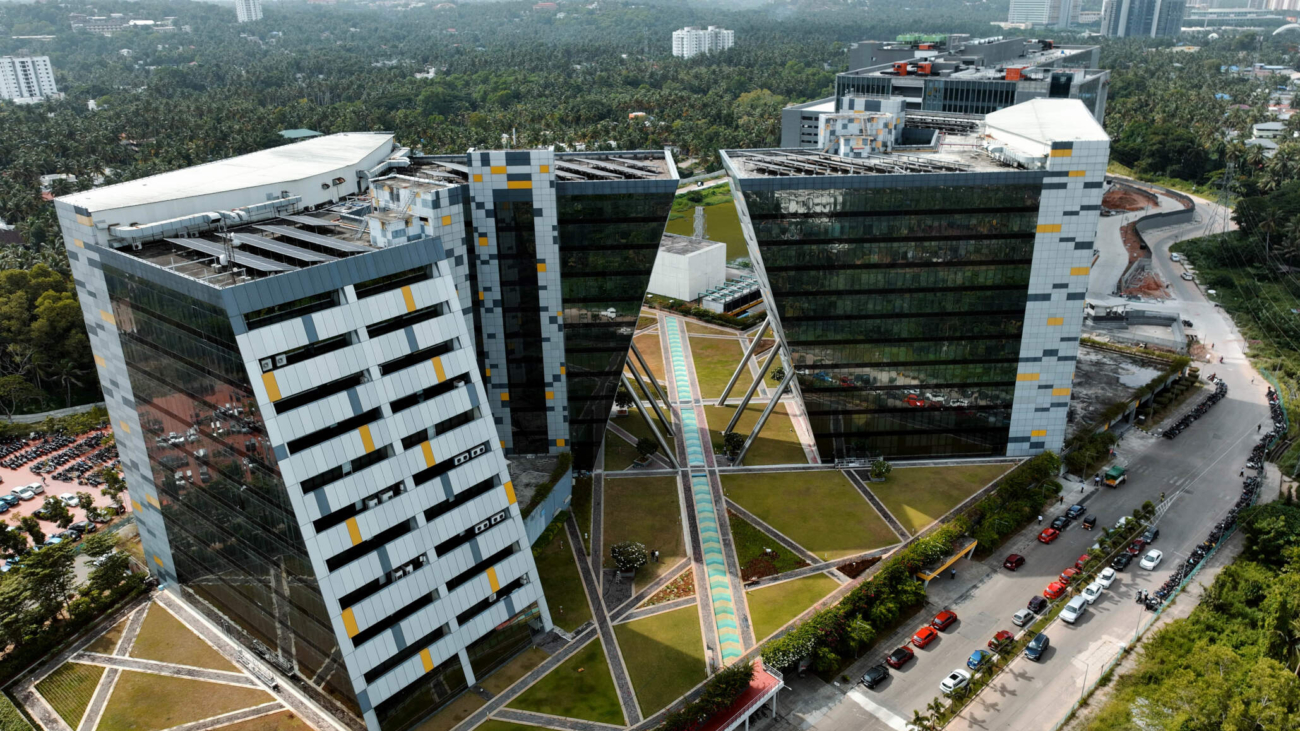
Thiruvananthapuram has all the ingredients of a high-value economic district, yet it continues to behave like a capital city economy built around government employment, slow services, and seasonal tourism. This is not a problem of potential. It is a problem of economic imagination. Few districts in India simultaneously possess large-scale IT employment, an international airport, a deep-sea transshipment port coming online, strong medical capacity, and steady foreign tourist inflows. When these assets are viewed separately, they look impressive. When viewed together, they represent a missed economic transformation.
The district’s biggest mistake has been fragmentation. Technopark grew, but remained mentally isolated from the rest of the district economy. The airport expanded passenger traffic, but never became a serious cargo and trade-services node. Vizhinjam port is emerging as a global maritime asset, yet district-level planning has barely begun around logistics, warehousing, trade services, and maritime-linked skills. Tourism remained focused on footfall rather than value creation. Each asset moved forward independently, without a unifying economic strategy.
District Industry White Paper Thiruvananthapuram_ A 3-Cluster Plan for 2030 and 2040
Thiruvananthapuram should not try to become everything. Its strength lies in three tightly linked engines. The first is a digital and deep-tech economy anchored by Technopark, but expanded beyond seat-count IT into AI, cyber security, health-tech, gov-tech, and maritime tech. With the right talent pipelines and procurement-linked pilots, this alone can generate tens of thousands of high-productivity jobs over the next decade.
The second engine is maritime and logistics. Vizhinjam port changes the district’s economic destiny only if it is surrounded by value-adding services. Freight forwarding, container operations, cold-chain logistics, export packaging, customs services, ship maintenance, and trade finance can create a large employment base without heavy manufacturing. Ports do not create prosperity by themselves. The ecosystem around them does.
The third engine is health, knowledge, and high-value tourism. Thiruvananthapuram already attracts foreign visitors, patients, students, and researchers. Yet the district treats tourism as a seasonal activity rather than a structured economy. Medical tourism, long-stay wellness, conventions, research events, and cultural circuits can convert visitor numbers into sustained income and employment, especially when linked to the airport and healthcare institutions.
What has held the district back is governance design. No single institution is accountable for district-level economic outcomes. Job creation, private investment, logistics performance, and visitor value are not tracked as political metrics. Without ownership, even strong assets underperform. Thiruvananthapuram needs to be governed as an economic mission, not an administrative territory.
District Industry White Paper Thiruvananthapuram_ A 3-Cluster Plan for 2030 and 2040
The opportunity window is narrow but real. Vizhinjam will attract global attention. Technopark continues to expand. International mobility is rising again. If these forces are aligned through a district-specific industrial plan with clear targets, Thiruvananthapuram can become Kerala’s highest-value district within fifteen years.
If they remain siloed, the district will continue to look prosperous on paper while exporting its talent and opportunity elsewhere. Capital cities do not automatically become economic engines. They have to be designed that way.
