
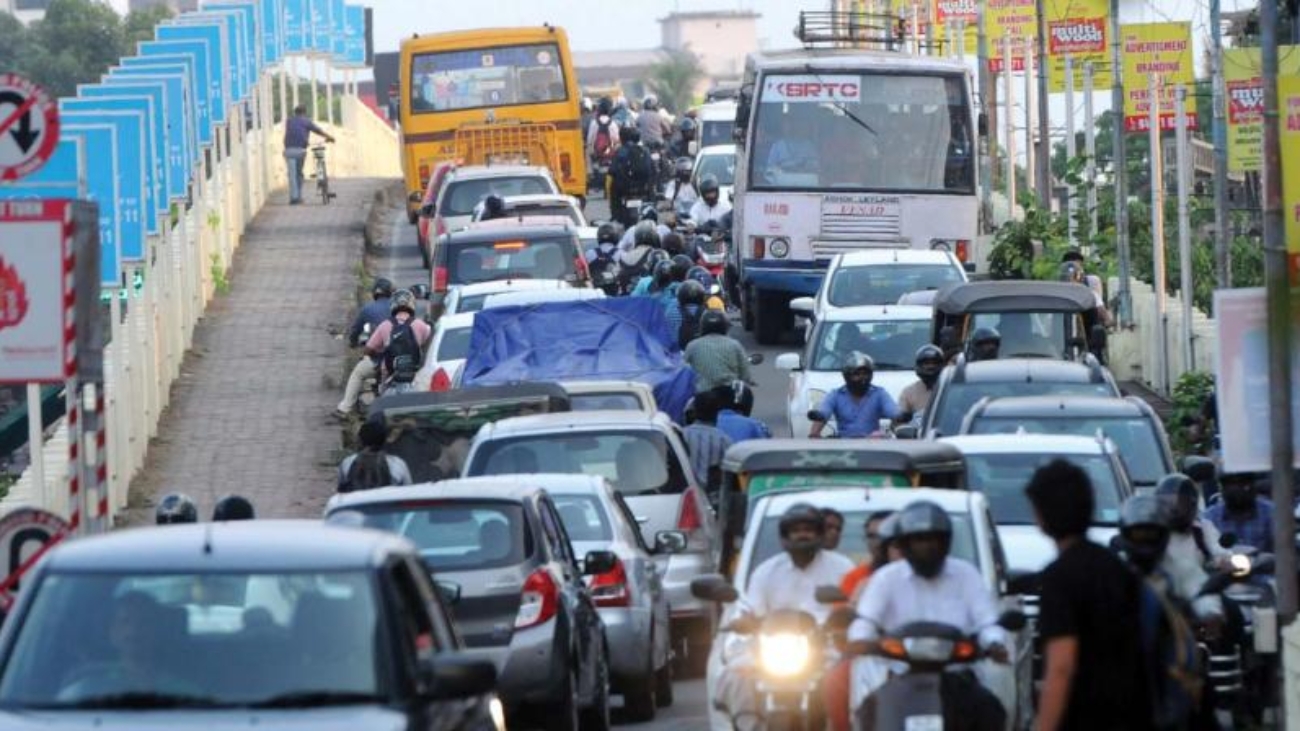
Kerala’s economic and administrative engines—Kochi and Thiruvananthapuram—are entering a period of unsustainable congestion. Roads are saturated, utilities are stretched, land prices have spiralled, drainage networks are overwhelmed, and public service delivery is strained. These two cities have absorbed decades of institutional expansion, high-skilled employment, educational demand, and inward migration without the corresponding spatial planning or infrastructural scaling. By 2047, if left unmanaged, both cities risk crossing a threshold where congestion undermines their economic competitiveness, quality of life, and climate resilience. Kerala Vision 2047 must therefore draft a bold, state-wide urban restructuring strategy that redistributes opportunity, builds new urban nodes, and makes Kochi and Thiruvananthapuram liveable centres rather than over-burdened magnets.
The root of overcrowding in these cities lies in Kerala’s paradoxical urban pattern. The state has no single dominant megacity; instead, it has a continuous urban-rural ribbon. Yet within this ribbon, economic activity has clustered disproportionately in Kochi and Thiruvananthapuram. Kochi, with its port, airport, IT parks, health sector, logistics economy, and tourism gateway, has become the state’s commercial capital. Thiruvananthapuram, with its administrative institutions, Technopark, research centres, and educational hubs, has become the state’s knowledge and governance capital. The result is a heavy concentration of jobs, institutions, and services in a limited geographic area that was never designed to handle such density.
Vision 2047 must begin by rebalancing Kerala’s urban hierarchy. Instead of allowing Kochi and Thiruvananthapuram to absorb all high-value growth, the state must develop at least four additional secondary cities—Kozhikode, Thrissur, Kollam, and Kannur—into fully equipped metropolitan hubs. Each must have world-class transport connectivity, integrated industrial zones, IT corridors, universities, and social infrastructure to attract businesses and residents. When opportunity is dispersed across the state, natural migration pressure on Kochi and Thiruvananthapuram will reduce. Urban rebalancing is not about shrinking existing cities but about expanding the urban system so that no single location becomes overwhelmed.
Inside Kochi and Thiruvananthapuram themselves, Kerala must shift from horizontal expansion to vertical and transit-oriented development. Both cities have grown outward into peri-urban zones without cohesive planning. This pattern forces residents into long commutes, increases vehicle dependency, and overloads narrow arterial roads. By 2047, these cities must adopt compact growth centred around mass transit systems—metro lines, suburban rail, water metros, and electric bus corridors. New housing, business districts, educational institutions, and cultural spaces must be concentrated along these transit routes. Transit-oriented planning reduces congestion, lowers pollution, and frees land for public spaces and climate buffers.
Drainage and water management must be completely redesigned. Kochi’s flooding is no longer an occasional inconvenience; it is a structural threat linked to wetland loss, canal encroachment, and intense monsoon patterns. Thiruvananthapuram’s drainage system also remains vulnerable, especially during cloudbursts. By 2047, both cities must restore their hydrological networks—reviving canals, widening drains, reclaiming natural floodplains, and constructing smart drainage channels with real-time monitoring. Urban planning must integrate blue-green infrastructure so that every neighbourhood has permeable surfaces, retention ponds, green corridors, and restored water bodies. Without such ecological redesign, congestion will combine with climate stress to make these cities increasingly uninhabitable.
Housing affordability is a major dimension of overcrowding. In both cities, prices have risen far beyond what young families, returnees, or mid-level professionals can afford. This pushes people to distant suburbs, increasing daily travel stress and contributing to traffic congestion. Kerala must create mixed-income housing zones within city limits, incentivise rental housing, and regulate speculative development. Public housing must be redesigned to be high-quality, mixed-use, and accessible to transit nodes. The state should also explore micro-housing options, cooperative housing models, and digitised land pooling to free up land for sustainable development. A city with affordable housing naturally reduces chaotic expansion.
Mobility reform is another pillar. Kochi and Thiruvananthapuram have both reached road saturation, where increasing road width no longer solves congestion. The solution is reducing vehicle dependency itself. By 2047, both cities must aim for 60–70 percent of trips to be made via public transport, cycling, or walking. This requires seamless integration of metros, buses, water transport, and bicycles into a single system with unified ticketing, dynamic scheduling, and real-time route information. Footpaths must be rebuilt as continuous, safe, shaded corridors, not fragmented or encroached strips. Cycling lanes must be protected and connected to major institutions and residential clusters. When mobility becomes multimodal and predictable, city life becomes less stressful and more efficient.
Administrative decentralisation can also reduce overcrowding. Many people travel into Kochi or Thiruvananthapuram daily because government offices are concentrated there. By 2047, major administrative functions—revenue offices, licensing authorities, state agencies, and service centres—should be digitally accessible or physically decentralised to satellite towns. This reduces daily traffic load and ensures citizens do not have to travel long distances for routine services. E-governance can eliminate millions of trips each year, dramatically easing congestion.
A balanced urban future must also address economic strategy. Currently, most high-value jobs are located in these two cities, attracting constant inward migration from across Kerala. The state must establish industrial corridors and innovation clusters in other regions—MarineTech in Kollam, AI-healthcare in Kozhikode, green manufacturing in Palakkad, creative industries in Wayanad, and logistics hubs in Kannur. When economic diversity spreads geographically, population pressure stabilises. Kochi and Thiruvananthapuram will remain important, but they will no longer have to bear the weight of the entire state’s ambitions.
Public spaces are essential to relieve psychological congestion. Overcrowding is not just physical; it is emotional. Both cities require more parks, waterfront promenades, cultural squares, open-air performance zones, sports complexes, and community spaces where citizens can relax, express, and gather. By 2047, both cities should adopt the “15-minute city” approach, ensuring that residents can reach essential services, recreation, and employment zones within a short walk or cycle. This model reduces travel time, boosts well-being, and makes cities more humane.
The final dimension is governance. For Kochi and Thiruvananthapuram to become sustainable by 2047, they require empowered, professionalised city governments. Urban management must shift from fragmented departments to unified metropolitan authorities that oversee transport, land use, environment, disaster resilience, and economic development. Without governance reform, even the best plans remain stuck. Cities thrive when they are given autonomy, resources, and accountability.
Kerala Vision 2047 must therefore pursue a simple but powerful idea: overcrowding is not inevitable. It is the result of choices. And with new choices, Kerala can build cities that are balanced, resilient, spacious, and globally competitive. Kochi and Thiruvananthapuram will remain the heart of Kerala—but the heart must not be overworked. A future where opportunity is distributed, mobility is efficient, climate risks are mitigated, and neighbourhoods are humane will ensure that both cities continue to thrive without collapsing under their own weight.
