
Kerala’s digital infrastructure vision is strengthened not only by campuses and connectivity, but by deep technological capability in high-performance computing, advanced software systems and national-scale digital research. The Centre for Development of Advanced Computing, commonly known as C-DAC, represents this layer of capability. With a presence in Kochi as part of its national network, C-DAC connects Kerala to India’s core digital research and strategic computing ecosystem. As Kerala looks toward 2047, institutions like C-DAC ensure that the state is not merely a consumer of technology, but a contributor to national and global digital capacity.
C-DAC was established in 1988 with a clear national mandate to build indigenous computing capability at a time when India faced technology denial regimes and limited access to advanced hardware. Over nearly four decades, it has evolved into a premier R&D organisation operating in areas such as high-performance computing, cybersecurity, language technologies, health informatics, embedded systems and cloud platforms. The Kochi centre plays a specialised role within this network, contributing to research, development and deployment projects that directly intersect with Kerala’s digital infrastructure ambitions.
High-performance computing is one of C-DAC’s most strategically important contributions. Modern governance, climate modelling, disaster prediction, genomics and artificial intelligence all depend on massive computational power. Nationally, C-DAC has been responsible for developing and deploying supercomputing systems under initiatives such as PARAM. These systems operate at petaflop-scale performance, processing trillions of calculations per second. While such numbers may seem abstract, their practical relevance to Kerala is growing rapidly as the state confronts climate risks, healthcare challenges and infrastructure planning needs that require advanced simulation and data analysis.
Kerala’s vulnerability to floods, landslides and extreme weather events makes computational modelling a necessity rather than a luxury. Accurate rainfall prediction, river basin modelling and landslide risk mapping require high-resolution data and large-scale computation. Through collaboration with national agencies and state departments, C-DAC’s expertise enables such models to be developed and refined. As data volumes increase by factors of 5 or 10 over the next two decades, the role of advanced computing infrastructure becomes even more central to public safety and planning.
Language technology is another area where C-DAC’s work aligns closely with Kerala’s digital inclusion goals. India’s linguistic diversity presents a major barrier to digital access, and Malayalam is no exception. C-DAC has been instrumental in developing Indian language computing tools, including fonts, text processing, speech recognition and translation systems. These technologies enable government portals, educational platforms and digital services to function effectively in Malayalam, ensuring that digital infrastructure serves all citizens rather than only English-proficient users. If even 30 to 40 percent more citizens can access services due to language enablement, the social return on investment is enormous.
Cybersecurity represents a third critical domain. As Kerala’s digital infrastructure expands to thousands of government systems and millions of users, the attack surface increases proportionally. C-DAC contributes to national cybersecurity tools, secure communication platforms and encryption technologies. These capabilities support secure e-governance, defence applications and critical infrastructure protection. For a state handling crores of digital transactions annually, even a small reduction in vulnerability translates into significant risk mitigation and trust preservation.
C-DAC’s role in health informatics is increasingly relevant to Kerala’s demographic future. With an ageing population projected by 2047, healthcare systems will face rising demand and complexity. C-DAC has worked on digital health platforms, hospital information systems and decision-support tools that integrate clinical data at scale. Such systems can process lakhs or crores of patient records to identify trends, optimise resource allocation and support preventive care. When combined with statewide connectivity and digital health initiatives, advanced informatics becomes a force multiplier for public healthcare delivery.
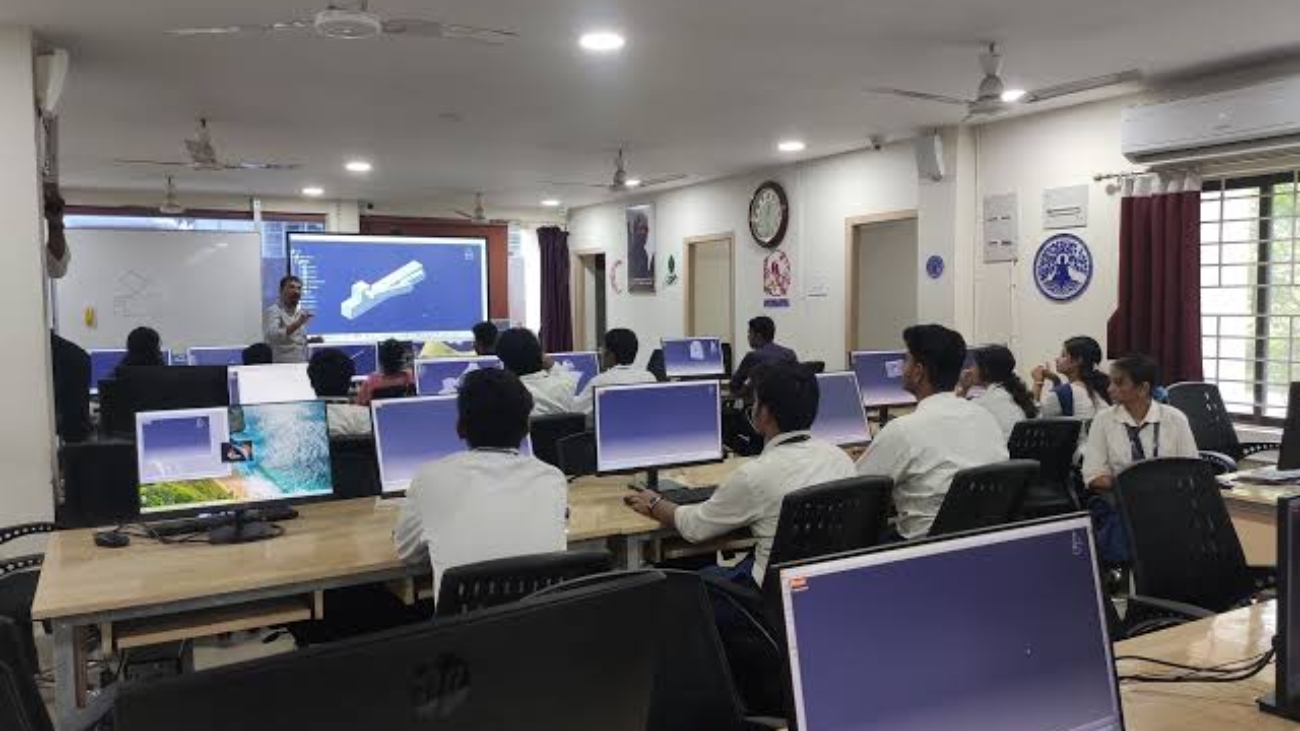
The institution’s contribution to capacity building is equally significant. Every year, C-DAC trains thousands of engineers, professionals and government staff through specialised programmes in advanced computing, cybersecurity and system design. Many of these trainees go on to work in government projects, IT parks, startups and national missions. Over a 20-year horizon, this continuous skill infusion builds a cadre of professionals capable of managing and evolving complex digital systems. For Kerala, this human capital layer complements physical infrastructure investments made in fibre networks and campuses.
C-DAC also acts as a bridge between research and deployment. Unlike purely academic institutions, it operates at the intersection of lab-scale innovation and real-world implementation. Solutions developed at C-DAC are often deployed in government departments, public sector units and national platforms. This applied orientation ensures that advanced technologies do not remain confined to pilot stages but scale into operational systems. For Kerala’s digital infrastructure, this reduces the gap between aspiration and execution.
Strategically, C-DAC’s presence connects Kerala to national missions in electronics, semiconductors, artificial intelligence and digital sovereignty. As India invests billions of dollars in indigenous technology capability over the next two decades, states with strong institutional linkages will benefit disproportionately. Kerala’s ability to align its digital infrastructure initiatives with national platforms ensures access to expertise, funding and strategic projects that go beyond state-level budgets.
By 2047, the complexity of digital systems governing everyday life will increase dramatically. Smart grids, autonomous transport, AI-assisted governance and personalised healthcare will all depend on advanced computation and secure software foundations. Institutions like C-DAC ensure that Kerala is prepared for this complexity. They provide depth, resilience and strategic autonomy to the state’s digital ecosystem.
In essence, C-DAC represents the deep-tech layer of Kerala’s digital infrastructure vision. While fibre networks connect people and campuses employ talent, advanced computing institutions enable foresight, security and innovation at scale. Their impact may not always be visible to citizens, but by 2047, the quality of governance, resilience and technological confidence Kerala enjoys will owe much to the foundations laid by such institutions.
