
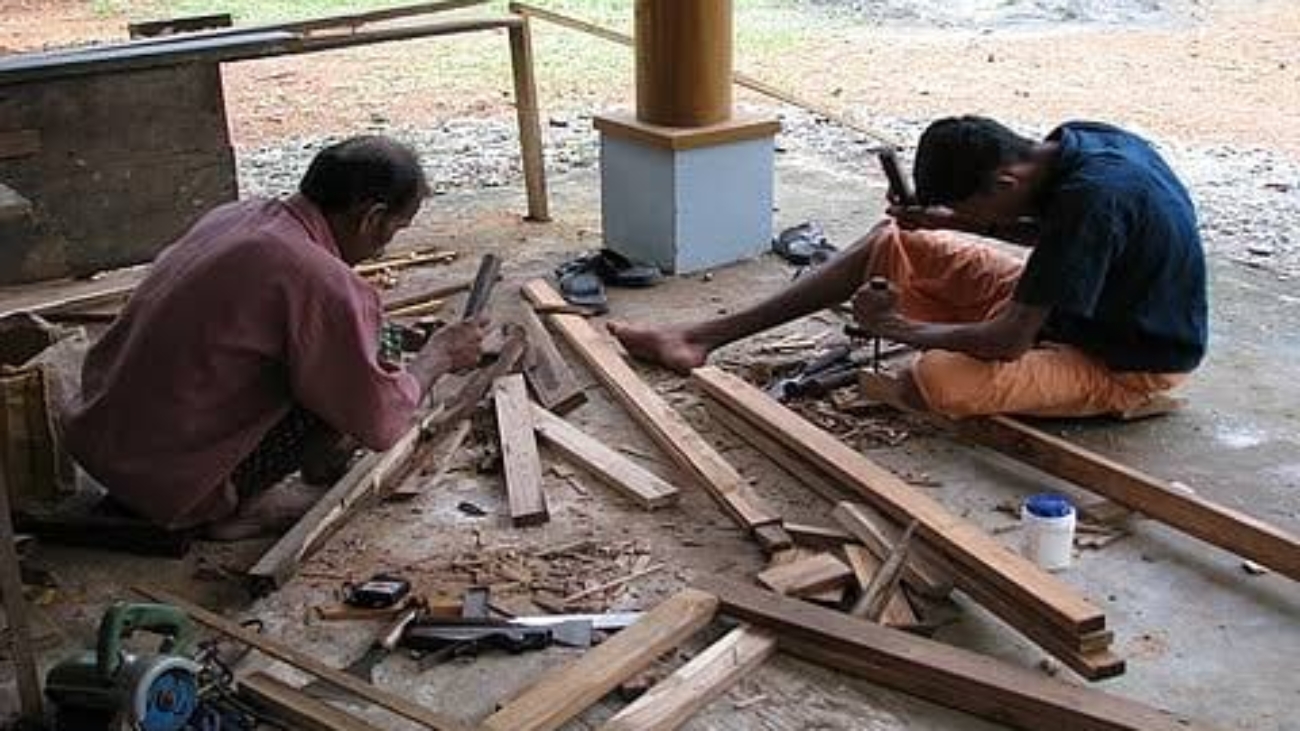
Thachar / Thatcher and related traditional carpenter communities in Kerala have historically been the primary builders of domestic housing, boats, agricultural structures, temples, granaries, and everyday wooden infrastructure. Long before reinforced concrete and prefab systems entered the state, these communities defined Kerala’s built environment using timber science, joinery logic, climate-adapted roofing, and load-bearing design principles refined over centuries. Their work was not merely manual; it embodied structural engineering suited to high rainfall, humidity, and coastal conditions.
In the present economy, this knowledge base has been systematically marginalised. Concrete construction, migrant labour dependency, and contractor-led projects have pushed traditional carpentry into a narrow role of shuttering, formwork, and low-margin finishing work. As a result, most Thachar workers today earn between ₹18,000 and ₹28,000 per month, often working under others despite possessing skills that should command premium pricing. Kerala imports modular furniture, prefab housing components, doors, windows, and engineered wood products worth over ₹8,000 crore annually, while its own carpenter base remains underutilised.
Kerala Vision 2047 must reposition Thachar communities as a modern timber and engineered-wood production workforce. Kerala’s annual construction expenditure exceeds ₹1 lakh crore, with housing alone accounting for nearly ₹45,000 crore. Even a 10 percent substitution of imported or non-local wood-based components with locally manufactured, certified products represents a ₹4,500 crore annual opportunity. This is achievable only if carpentry is upgraded from site-based labour to workshop-based manufacturing.
The first intervention is the creation of district-level wood engineering and carpentry manufacturing clusters. Kerala has 14 districts; establishing three clusters per district results in 42 units statewide. Each cluster, with a capital outlay of ₹20–₹25 crore, can house CNC routers, seasoning kilns, modular assembly lines, finishing booths, and testing labs. At full capacity, each unit can employ 250–300 skilled workers directly and support another 500 indirectly through supply chains. This creates direct employment for over 10,000 upgraded carpenters within a decade.
Skill modernisation is central. Traditional Thachar expertise in joinery, load paths, and material behaviour must be combined with modern tools such as CAD-based design, CNC machining, engineered wood composites, fire-retardant treatments, and moisture-control systems. A one-year advanced carpentry and wood engineering program costing ₹75,000 per worker can upgrade 10,000 workers annually at a public investment of ₹750 crore over ten years. The productivity gains far outweigh this cost.
Income transformation follows industrialisation. A site-based carpenter earns daily wages with limited scalability. A workshop-based wood technician or supervisor earns ₹40,000–₹70,000 per month, while master fabricators and design-integrated carpenters can cross ₹1 lakh per month. If 50,000 workers transition into this model by 2047, and average net income rises by ₹35,000 per month, this injects over ₹21,000 crore annually into Kerala’s household economy.
Kerala Vision 2047 must align public procurement with this transformation. Government housing schemes, school buildings, anganwadis, tourism infrastructure, and public interiors together account for tens of thousands of crores in spending. Mandating certified local engineered-wood components for doors, windows, furniture, interiors, and roofing in public projects can create a stable demand pipeline worth ₹3,000–₹5,000 crore annually. This not only supports local industry but reduces lifecycle maintenance costs due to climate-appropriate design.
Sustainability and forestry integration are strategic advantages. Kerala imports timber while underutilising plantation wood, coconut timber, rubberwood, and bamboo composites. Thachar-led manufacturing units can anchor value chains around treated rubberwood and engineered bamboo, reducing dependence on illegal or imported hardwoods. Kerala has over 5 lakh hectares under rubber; even partial conversion of ageing rubberwood into engineered products creates a circular rural-urban economy linking farmers and carpenters.
Technology-enabled exports are another frontier. Modular furniture, heritage-style wooden structures, prefabricated cottages, and climate-resilient housing components have strong demand in the Middle East, island nations, and tourism-heavy regions. With proper certification and design standards, Kerala-origin wood products can capture niche export markets. A conservative export target of ₹5,000 crore annually by 2047 is achievable with coordinated branding and logistics.
Disaster resilience adds another dimension. Flood-resilient wooden housing systems, elevated flooring modules, and quick-assembly shelters can be developed and stockpiled. Thachar communities, trained in rapid fabrication and assembly, can form the backbone of Kerala’s post-disaster reconstruction capability, reducing response time and cost.
Intergenerational continuity is at stake. Younger members abandon carpentry not due to lack of pride, but lack of future visibility. A Vision 2047 pathway that clearly maps progression from apprentice to technician to designer to enterprise owner can reverse this trend. If even 15 percent of trained workers transition into ownership roles over 20 years, Kerala gains thousands of small and medium manufacturing enterprises rooted in skill rather than speculation.
By 2047, a modernised Thachar-led wood engineering sector can realistically generate ₹30,000–₹35,000 crore annually in value, reduce import dependence, and restore Kerala’s identity as a climate-smart construction innovator. This is not nostalgia-driven development; it is industrial strategy grounded in material science, local skill, and economic logic.
