
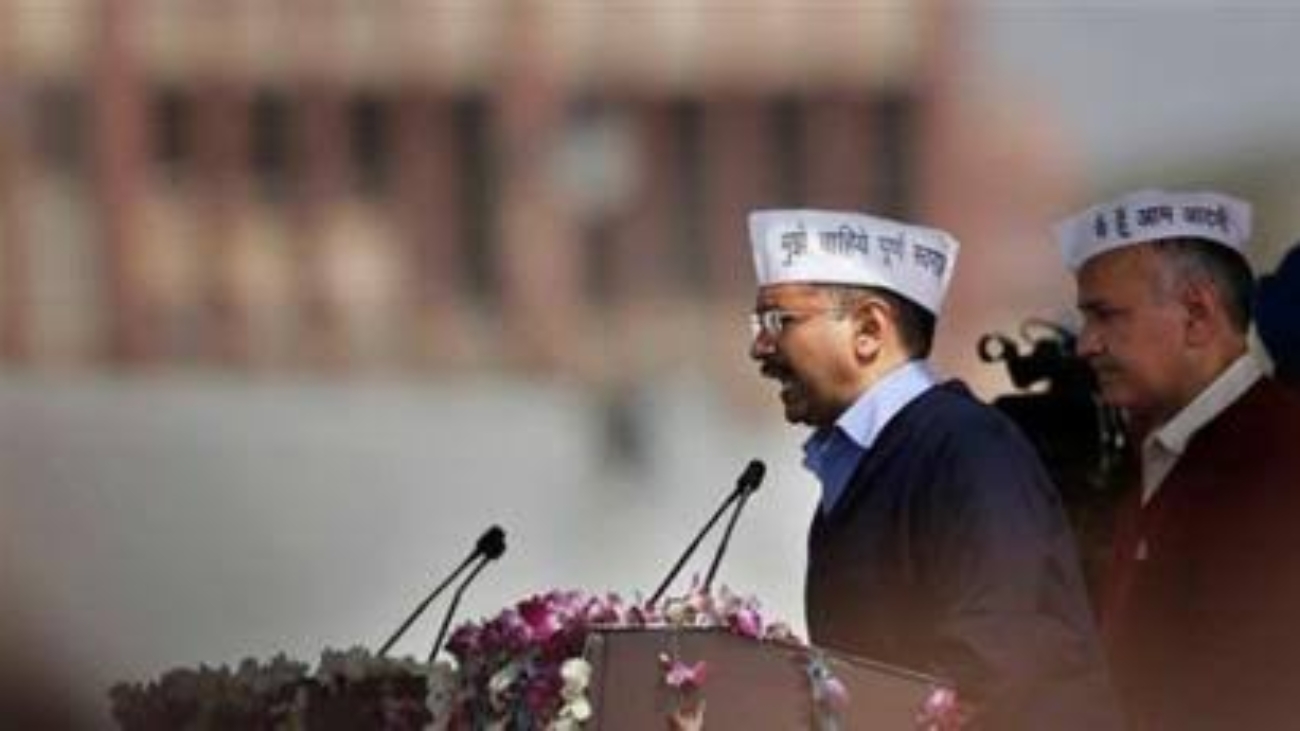
A central structural constraint shaping the future trajectory of the Aam Aadmi Party is its heavy overdependence on a single leadership persona. This dependence was instrumental to the party’s rise, but it now functions as a bottleneck that limits institutional maturity, regional credibility, and long-term resilience.
AAP emerged in a political vacuum created by public anger against corruption and elite unresponsiveness. In that moment, strong, recognisable leadership was not just useful but necessary. Arvind Kejriwal became the symbolic and operational centre of the movement, translating protest energy into electoral success. His administrative focus, communication clarity, and confrontation with entrenched power structures gave the party coherence and momentum when it mattered most.
However, political organisations that remain centred too long around one individual face a predictable transition problem. Leadership that initially unifies can later constrain. As AAP expanded beyond Delhi, its state units struggled to develop independent authority because legitimacy continued to flow vertically rather than horizontally. Regional leaders remained representatives of the central leadership rather than autonomous political actors rooted in local contexts.
This creates fragility at multiple levels. First, voter trust outside core strongholds becomes conditional. In states where Kejriwal is not physically or culturally present, the party often appears as an extension of a distant leadership rather than a locally embedded force. Indian voters, especially at the state level, value familiarity and accessibility. Charisma does not travel well without institutional anchoring.
Second, leadership centralisation weakens succession planning. Parties endure when leadership renewal is visible and credible. In AAP’s case, the absence of clearly empowered second-tier national leaders creates uncertainty. Capable leaders exist, but their authority remains derivative. This limits the party’s ability to project stability beyond its founding generation.
Third, organisational learning suffers. When strategic decisions are concentrated at the top, feedback loops narrow. Regional units become implementers rather than innovators. Mistakes are either repeated or concealed rather than openly debated and corrected. Over time, this reduces adaptability, especially in a country as politically diverse as India.
The dependence also affects volunteer culture. AAP attracted many idealistic volunteers who were drawn by reformist energy rather than party loyalty. Such volunteers expect participatory politics. When leadership appears centralised and non-negotiable, engagement becomes transactional. Enthusiasm fades into passive support or exit.
Electoral performance reflects this dynamic. Where Kejriwal’s leadership is directly visible and validated by governance outcomes, AAP performs strongly. Where that visibility weakens, the party struggles to break through. This pattern suggests that voters trust the leader more than the institution. For a national party, this is an unsustainable asymmetry.
The risk is not immediate collapse but long-term ceiling. Parties built around a single persona often achieve rapid early success and then plateau. Expansion requires decentralised authority, ideological confidence at multiple levels, and leaders who can speak credibly for the party without constant central validation.
This does not require diminishing the founding leadership. It requires deliberate institutionalisation. Successful transitions convert personal authority into organisational culture. They create space for regional leaders to fail, learn, and grow without threatening central legitimacy. Without this shift, every expansion attempt remains fragile and reversible.
AAP’s challenge, therefore, is one of evolution rather than correction. The question is whether it can transform from a leader-led party into a leader-founded party. The difference is subtle but decisive. One depends on continuous central presence; the other survives its absence.
In a political system as vast and varied as India’s, no single leader can substitute for institutional depth indefinitely. Trust must eventually attach to the party itself, not just to its most recognisable face. Until that transition is made, AAP’s growth will remain impressive but bounded.
