
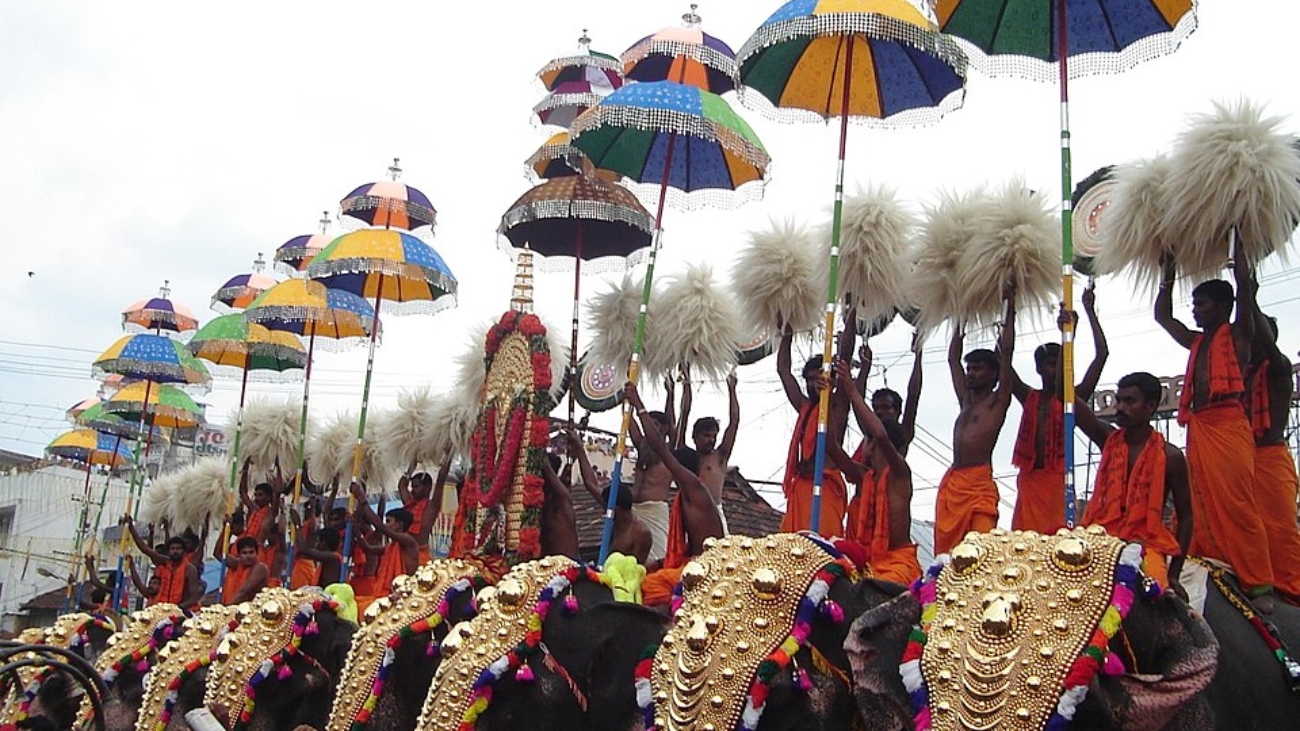
Thrissur’s temple economies operate at a scale that is both immense and strangely under-analysed. Thousands of rituals, festivals, daily services, pilgrim flows, informal vendors, artisans, volunteers, transport providers, and support workers interact continuously around temple spaces. Money moves, labour circulates, and social coordination occurs with remarkable reliability. Yet almost none of this activity is studied, optimised, or designed as an economic system. It functions on tradition, intuition, and habit rather than intelligence. This gap is not a cultural flaw. It is a policy blind spot.
Temples in Thrissur are not merely religious institutions. They are complex socio-economic organisms. They generate demand for food, flowers, crafts, music, logistics, cleaning, security, accommodation, transport, and ritual expertise. They concentrate footfall in predictable rhythms across days, seasons, and years. They mobilise volunteers and donations at a scale that many formal institutions struggle to achieve. And yet, these systems operate almost entirely without data, planning tools, or feedback loops.
The prevailing assumption is that introducing intelligence into temple economies risks commercialisation or dilution of sanctity. This fear has led to a false choice between reverence and organisation. As a result, temple economies remain inefficient, extractive in subtle ways, and vulnerable to burnout. Tradition is preserved, but potential is wasted. Sanctity is protected, but sustainability is not designed.
The most immediate consequence of this intelligence gap is invisible inefficiency. Crowds surge and recede without optimisation. Vendors compete chaotically. Waste management becomes reactive. Temporary labour is overused during festivals and underutilised otherwise. Artisans depend on seasonal patronage rather than steady demand. None of this appears as crisis, which is why it remains unaddressed. It appears as normal.
Another consequence is value leakage. Large volumes of economic activity associated with temples flow outward rather than strengthening local ecosystems. Accommodation, transport, food supply, and services are often captured by intermediaries with no long-term stake in the district. Local talent participates, but rarely accumulates durable value or skill progression. The economy circulates, but does not compound.
Temple governance structures are not designed to solve this problem. Their mandate is spiritual continuity and ritual correctness, not economic optimisation. Expecting them to self-generate economic intelligence without support is unrealistic. At the same time, imposing external commercial logic without sensitivity would be destructive. The challenge is to design a layer that observes, supports, and enhances temple economies without interfering in religious authority.
Vision Kerala 2047 requires Thrissur to move beyond this stalemate. The goal is not to turn temples into businesses, but to recognise that economic activity already exists and deserves thoughtful design. Intelligence here does not mean monetisation. It means visibility. Understanding flows, pressures, and capacities allows better decisions that benefit devotees, workers, and surrounding communities.
A temple economy intelligence approach begins with mapping, not control. Footfall patterns, service demand cycles, waste generation, labour requirements, and vendor distribution can be observed without intruding into rituals. Such observation respects sanctity while improving functionality. When patterns are visible, simple interventions can dramatically reduce stress and waste.
For example, festival periods repeatedly overwhelm sanitation systems, leading to post-event degradation. This is not a moral failure; it is a planning failure. With basic data, sanitation resources can be rotated, labour schedules balanced, and recovery protocols standardised. The same applies to crowd movement, emergency access, and vendor placement. Intelligence replaces improvisation.
Artisans and cultural workers form another neglected layer. Thrissur’s temple-linked art forms depend on seasonal commissions and personal networks. There is little continuity of income or systematic skill transmission. Without intelligence on demand, training pipelines, and generational transitions, these art forms survive heroically but precariously. A supportive intelligence layer could stabilise livelihoods without altering artistic autonomy.
Volunteers, too, are an under-recognised economic force. Their labour is immense, especially during festivals. Yet there is no system to manage fatigue, rotation, or recognition. Burnout is common, but silent. Intelligence allows care. When participation is tracked respectfully, workloads can be shared more fairly and sustainably.
Local businesses orbiting temple economies face similar issues. Food vendors, flower sellers, transport operators, and small retailers experience erratic income tied to festival spikes. With better forecasting and coordination, demand can be smoothed, quality improved, and exploitation reduced. This benefits devotees as much as providers.
The absence of intelligence also affects safety. Emergency preparedness relies heavily on experience rather than structured planning. While this has worked remarkably well, it is risky in a context of increasing crowd sizes and climate volatility. Intelligence-informed preparedness enhances safety without invoking fear or heavy-handed control.
There is also a missed opportunity for knowledge export. Thrissur’s temple management practices, festival coordination methods, and ritual logistics represent a form of organisational intelligence refined over centuries. Yet none of this is documented or translated into transferable knowledge. Other regions struggle with large-scale cultural coordination while Thrissur’s experience remains tacit and local. This is a loss not just for the district, but for the wider world.
Critically, intelligence must not be centralised or extractive. Data ownership, observation rights, and usage boundaries must be carefully defined. Temple authorities must retain spiritual authority. Communities must retain agency. The intelligence layer exists to serve, not to govern. Without this trust, any attempt will fail.
Technology is not the starting point, but it is an enabler. Simple tools, respectful observation, and local participation matter more than sophisticated platforms. The danger is not under-technology, but overreach. The right question is not what can be measured, but what should be understood.
Cultural sensitivity is not a constraint to design around; it is the design principle itself. Thrissur’s temple economies endure because they are embedded in collective belief. Intelligence that ignores this will be rejected. Intelligence that respects it will be welcomed, even if quietly.
By 2047, temple economies in Thrissur will face increasing pressure. Larger crowds, fewer volunteers, higher expectations of safety and cleanliness, and more complex urban environments will strain systems built on intuition alone. Ignoring this trajectory risks future breakdowns that could have been prevented with gentle foresight.
The alternative is a future where temple economies remain spiritually intact while becoming operationally resilient. Where workers are less exhausted, waste is less visible, artisans are more secure, and devotees experience dignity rather than chaos. None of this requires altering belief. It requires attention.
Thrissur has an opportunity to demonstrate a uniquely Indian model of economic intelligence that does not worship efficiency at the cost of meaning. It can show that sanctity and systems are not opposites, but complements when designed with humility.
