
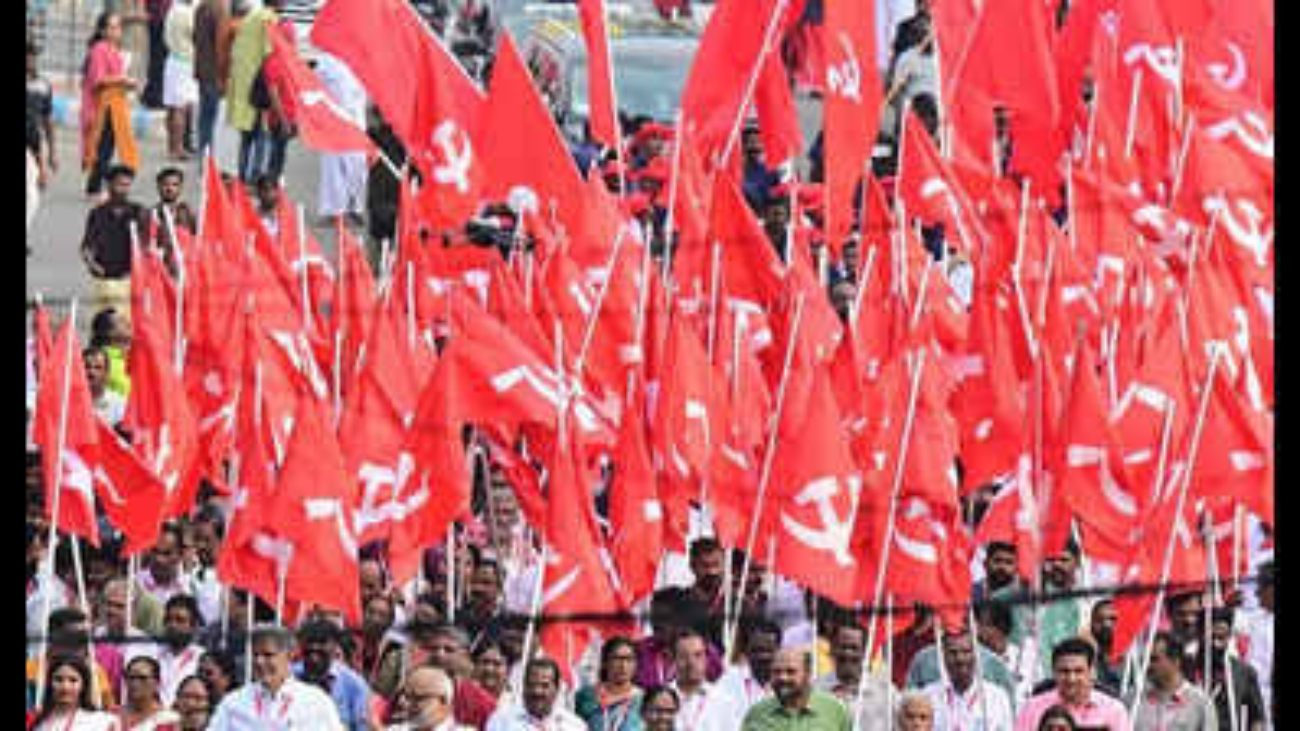
The ideological language of the Communist Party of India (Marxist) in Kerala remains heavily anchored in a twentieth-century imagination of politics, even as the social and cognitive environment of society has transformed dramatically. This disjunction is most visible in how the party struggles to communicate with an educated, globally exposed, media-saturated population whose political consciousness is shaped less by class narratives and more by information flows, networks, and personal experience. The result is not a collapse of support, but a steady erosion of ideological resonance.
When CPI(M) expanded its influence in Kerala during the mid-twentieth century, political communication operated through physical presence. Party branches, study circles, trade unions, and local leaders were the primary conduits of information. Ideology was transmitted slowly, repeatedly, and collectively. Newspapers, public meetings, and pamphlets reinforced a shared worldview. This suited a society with limited media choices, stable communities, and strong local affiliations. Political identity was built over years, not weeks.
Kerala today exists in a radically different information environment. Literacy is near universal, higher education participation is high, and internet penetration has expanded rapidly. By the late 2010s, smartphone usage and social media access had become nearly ubiquitous across age groups. Political understanding is no longer mediated primarily by party institutions but by digital platforms, peer networks, global news cycles, and algorithm-driven content. Individuals consume fragmented, rapid, and often contradictory information streams rather than structured ideological education.
This transformation weakens traditional ideological transmission. CPI(M)’s discourse still relies heavily on long-form explanations, historical references, and collective memory. While intellectually coherent, this mode struggles in an environment where attention is scarce and narratives compete in real time. Younger audiences, in particular, respond to immediacy, personal relevance, and experiential authenticity rather than abstract ideological continuity.
A critical shift has occurred in how authority is perceived. In earlier decades, party affiliation itself conferred legitimacy. Being part of the movement signified moral seriousness and social commitment. Today, authority is increasingly individualised. Professionals, influencers, expatriates, subject-matter experts, and even anonymous commentators shape opinion. Ideological authority must now be earned continuously through relevance, clarity, and credibility rather than inherited through organisational lineage.
Education has further complicated this landscape. Kerala’s educated population is trained to question, compare, and evaluate. Exposure to global systems through migration, international media, and professional networks introduces alternative models of governance, economy, and social organisation. Concepts such as efficiency, scalability, innovation, and institutional design enter everyday political conversation. Ideological frameworks that do not engage these concepts directly appear incomplete, regardless of their moral intent.
This is particularly evident in discussions around governance. CPI(M)’s critique of neoliberalism, privatisation, and global capitalism often lacks granular engagement with policy trade-offs. Citizens who interact daily with private systems—banks, hospitals, digital platforms, global employers—expect nuanced positions rather than categorical opposition. When ideological language remains binary in a world experienced as complex, it loses explanatory power.
There is also a cultural shift in political participation. Traditional Left politics emphasised collective action, sacrifice, and discipline. Contemporary political engagement is more individualised and episodic. People sign petitions, share content, attend issue-specific protests, and disengage just as quickly. Long-term cadre commitment is less attractive in a society where careers, locations, and identities are fluid. An ideology that requires sustained organisational immersion struggles to recruit in such conditions.
Media itself has altered political incentives. Public discourse now rewards sharp statements, symbolic gestures, and emotional framing. CPI(M)’s ideological seriousness often translates poorly into this environment, making the party appear either defensive or out of step. Attempts to adapt sometimes feel performative rather than organic, reinforcing perceptions of lag rather than leadership.
The generational gap is especially pronounced. Older supporters interpret ideological continuity as stability and principle. Younger citizens often interpret the same continuity as rigidity. This does not necessarily produce hostility, but it does reduce emotional investment. Many younger voters engage with the Left pragmatically, supporting welfare measures or governance competence while remaining indifferent to ideological foundations.
Another dimension is the decline of shared historical memory. Events that once defined Left identity—anti-feudal struggles, early labour movements, Cold War alignments—carry diminishing emotional weight for generations born after the 1990s. Without lived memory, ideological references risk becoming symbolic rather than mobilising. History still matters, but it must be translated into contemporary relevance rather than invoked as authority.
The challenge is not that CPI(M)’s values are obsolete. Equality, dignity of labour, social justice, and collective welfare remain widely supported in Kerala. The problem lies in how these values are articulated. When ideology speaks in inherited language rather than adaptive frameworks, it struggles to shape perception in a fast-moving cognitive landscape.
Governance performance temporarily bridges this gap. Effective administration, welfare delivery, and crisis management generate trust independent of ideology. However, performance alone cannot sustain ideological relevance over decades. Without a compelling narrative that explains the present and imagines the future, governance success risks being viewed as managerial competence rather than political vision.
Globally, Left movements that retained relevance invested heavily in intellectual renewal. They developed new vocabularies around inequality, precarity, platform economies, and digital power. They engaged with technology, finance, and globalisation not only as threats but as systems to be reshaped. In Kerala, such renewal remains partial and uneven, constrained by institutional memory and internal cultural resistance.
The deeper issue is temporal mismatch. CPI(M)’s ideological clock runs slower than society’s experiential clock. When people’s lived realities change faster than political language, disconnect is inevitable. This does not produce immediate rejection, but it gradually reduces the party’s capacity to frame debate rather than respond to it.
Kerala’s future will be shaped by forces that demand new ideological tools: ageing demographics, climate stress, global labour mobility, artificial intelligence, fiscal constraints, and changing family structures. Addressing these requires frameworks that combine ethical commitment with technical imagination. An ideology that cannot speak fluently about systems risks being sidelined by those that can, even if they lack moral depth.
The question facing CPI(M) is therefore not whether ideology matters, but whether it can evolve at the speed required by contemporary society. Relevance in the coming decades will depend less on defending historical correctness and more on offering conceptual leadership in an uncertain world.
