
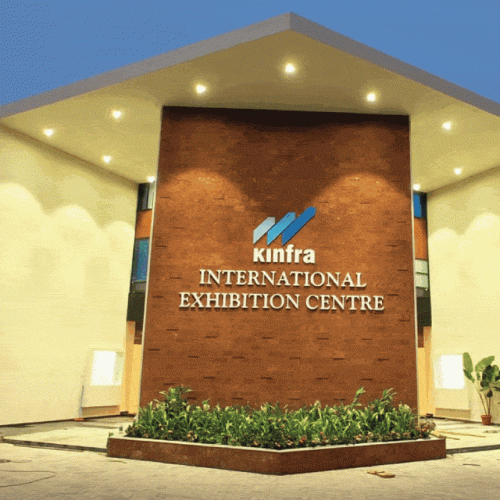
Kerala’s industrial weakness is not lack of talent or demand, but fragmentation. Enterprises operate side by side without shared systems, leading to duplicated costs, inconsistent quality, and weak bargaining power. The strategic opportunity for Kerala Industrial Infrastructure Development Corporation lies in designing sector-specific micro-ecosystems instead of generic industrial parks.
Most industrial parks assume that proximity alone creates synergy. In practice, firms co-locate but function independently, sourcing inputs separately, managing compliance alone, and struggling individually for market access. Sector-specific micro-ecosystems correct this by designing infrastructure, services, and governance around a single value chain. The park itself becomes an operating system, not just a location.
A micro-ecosystem embeds shared assets that are too expensive or complex for individual firms. This includes common testing and certification labs, shared quality control units, pooled procurement systems, export facilitation desks, and specialised waste or effluent treatment. When these are designed at the park level, even small firms can meet global standards without disproportionate cost.
Kerala is especially suited for this approach because its industrial future lies in precision and specialisation rather than mass manufacturing. Medical devices, food processing, Ayurveda products, climate services, electronics sub-assemblies, cultural industries, and marine products all benefit from tight ecosystem design. KINFRA can map these sectors and create parks where every infrastructure decision reinforces the same value chain logic.
Sector focus also improves policy alignment. When a park is dedicated to a defined industry, coordination with regulators, skill providers, financial institutions, and export bodies becomes easier. Training programs can be tailored, inspections become predictable, and incentives are better targeted. This reduces compliance anxiety and increases operational confidence for firms.
There is a resilience advantage as well. In a micro-ecosystem, firms learn from each other’s failures and successes in real time. Knowledge spillovers happen naturally, supply shocks are absorbed collectively, and innovation diffuses faster. This makes the entire cluster more stable than a collection of isolated units, even during market downturns.
From a public finance perspective, sector-specific parks improve return on infrastructure investment. Instead of spreading resources thinly across diverse needs, capital is concentrated where utilisation rates are high and learning effects compound. Over time, such parks develop reputational gravity, attracting suppliers, buyers, and talent organically.
By moving from generic industrial estates to purpose-built micro-ecosystems, KINFRA can help Kerala compete on intelligence and coordination rather than scale alone. This is a quiet structural shift with long-term impact, creating industries that are harder to displace and easier to sustain.
