
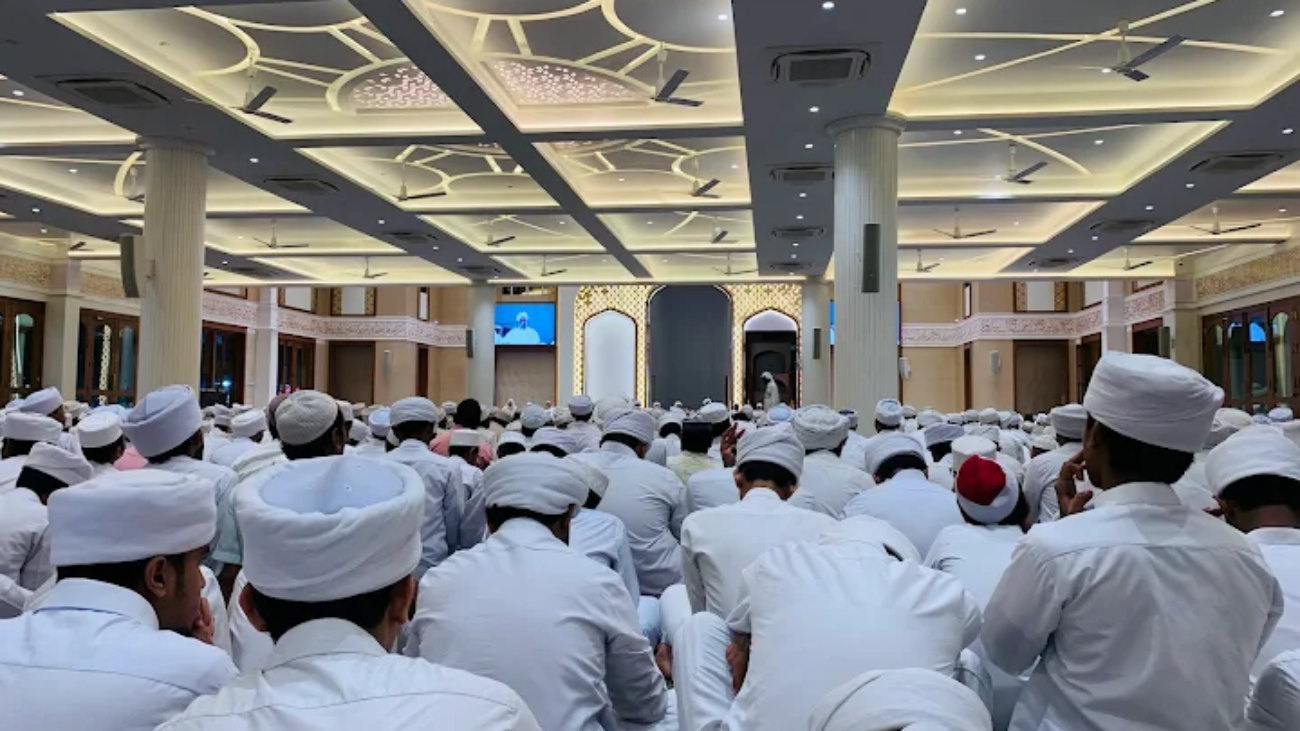
Malappuram’s NRI economy already operates through institutions the state refuses to see. Money moves, disputes are settled, trust is enforced, and obligations are honoured without courts, banks, or publicity. At the centre of this invisible system sit mosques—not as religious charities alone, but as social trust engines. Policy has consistently misunderstood this, either reducing mosques to welfare outlets or treating them as politically sensitive spaces to be avoided. Vision Kerala 2047 requires a far more improbable move: recognising selected mosques as neutral economic clearing houses for NRI–local economic integration.
An economic clearing house does not own capital, run businesses, or seek profit. It matches flows, verifies trust, buffers risk, and resolves friction. Historically, such functions were performed by guilds, merchant courts, and community institutions long before modern banks existed. In Malappuram, mosques already perform fragments of this role informally. NRIs route money through trusted committees. Local entrepreneurs seek introductions, not loans. Disputes are mediated quietly. Defaults are handled socially rather than legally. The system works precisely because it avoids publicity, bureaucracy, and formal enforcement.
The improbability of this policy lies in formalising function without formalising control. The state does not take over mosques. Mosques do not become banks. Instead, a narrow, clearly bounded economic role is recognised, regulated lightly, and protected legally. Selected mosques, based on governance capacity and community trust, are certified as economic clearing houses for specific NRI-linked transactions.
These clearing houses do not collect deposits. They do not invest. They do not promise returns. Their role is limited to four functions: identity verification, intent matching, trust signalling, and dispute buffering. An NRI who wishes to support or underwrite a local enterprise does not wire money blindly. They register intent with the clearing house. A local operator with a verified need does the same. The clearing house matches intent, facilitates structured introduction, and defines boundaries. Money moves directly between parties, not through the mosque.
This distinction is crucial. The mosque never becomes a custodian of funds. It becomes a credibility layer. Its value lies in social enforcement rather than financial intermediation. Because reputation matters deeply in Malappuram’s social fabric, the clearing house’s presence reduces opportunism without invoking courts or police. This is not moral policing. It is network discipline.
For NRIs, this model solves a central fear: anonymity with safety. Many Gulf NRIs want to contribute economically without becoming visible targets for requests, pressure, or political tagging. Clearing houses allow anonymous or low-visibility participation. The NRI’s name is known to the clearing committee, not the entire community. This sharply increases willingness to engage.
For local entrepreneurs, the benefit is equally strong. Access to NRI-linked capital and support is no longer dependent on personal proximity or family hierarchy. The clearing house introduces a degree of merit-based matching without importing bureaucratic scoring systems. Trust is evaluated relationally, not algorithmically. This fits Malappuram’s reality far better than credit scores or pitch decks.
The most radical aspect of this policy is dispute handling. Today, when NRI–local arrangements fail, they fail catastrophically. Either the issue is buried in silence, poisoning relationships for years, or it explodes socially. Clearing houses introduce structured, quiet mediation. When timelines slip or outcomes disappoint, the mosque committee intervenes early, not to assign blame, but to renegotiate scope, exit, or loss absorption. This prevents escalation and preserves long-term trust.
Importantly, this model does not romanticise religion. It recognises capacity. Not every mosque qualifies. Certification is limited, revocable, and based on governance standards such as audited committee structures, conflict-of-interest rules, record-keeping discipline, and rotational leadership. This protects against capture and politicisation. The state’s role is to certify function, not supervise belief.
There is also a macroeconomic implication. Malappuram’s informal finance is often accused of opacity and inefficiency. In reality, it is efficient but unmeasured. Clearing houses create light-touch visibility without destroying informality. Aggregate data on flows, sectors, and failure rates can be collected without exposing individuals. This allows policy learning without surveillance.
Critics will argue that this blurs the line between religion and economy. That line has never been clean in Malappuram. The real risk lies not in acknowledgement, but in denial. By pretending these systems do not exist, the state forfeits any chance to shape them ethically. Recognition with limits is safer than neglect.
Another concern is exclusion. What about non-Muslims or those outside mosque networks? The answer is not to universalise this model indiscriminately, but to allow institutional pluralism. Other community institutions may develop parallel clearing functions appropriate to their social structures. The state’s role is to recognise function wherever trust already exists, not to impose uniformity.
This policy also reframes the mosque’s role in a subtle but important way. It shifts emphasis from charity to circulation. Charity addresses failure after it occurs. Clearing houses prevent failure by designing safer engagement upfront. This is a more dignified economic role for both giver and receiver.
Over time, this system changes behaviour. NRIs stop sending money impulsively and start engaging structurally. Local operators stop seeking one-time help and start building credible plans. Failure becomes manageable rather than shameful. Exit becomes possible without social rupture. Trust deepens because it is exercised, not merely assumed.
The improbability of mosque-linked economic clearing houses lies in their refusal to look modern. There are no apps to showcase, no press releases to issue, no grand announcements to make. The system works quietly or not at all. Its success is measured in reduced conflict, sustained enterprises, and repeat engagement—not headlines.
By 2047, Malappuram will not succeed by copying industrial corridors or startup models from elsewhere. Its strength lies in dense social capital and disciplined informality. This policy does not try to replace that strength. It stabilises it, protects it, and allows it to interface with global NRI capital without being distorted.
Mosques already anchor Malappuram’s moral economy. Allowing them to anchor a bounded slice of its economic interface is not radical. It is honest.
