
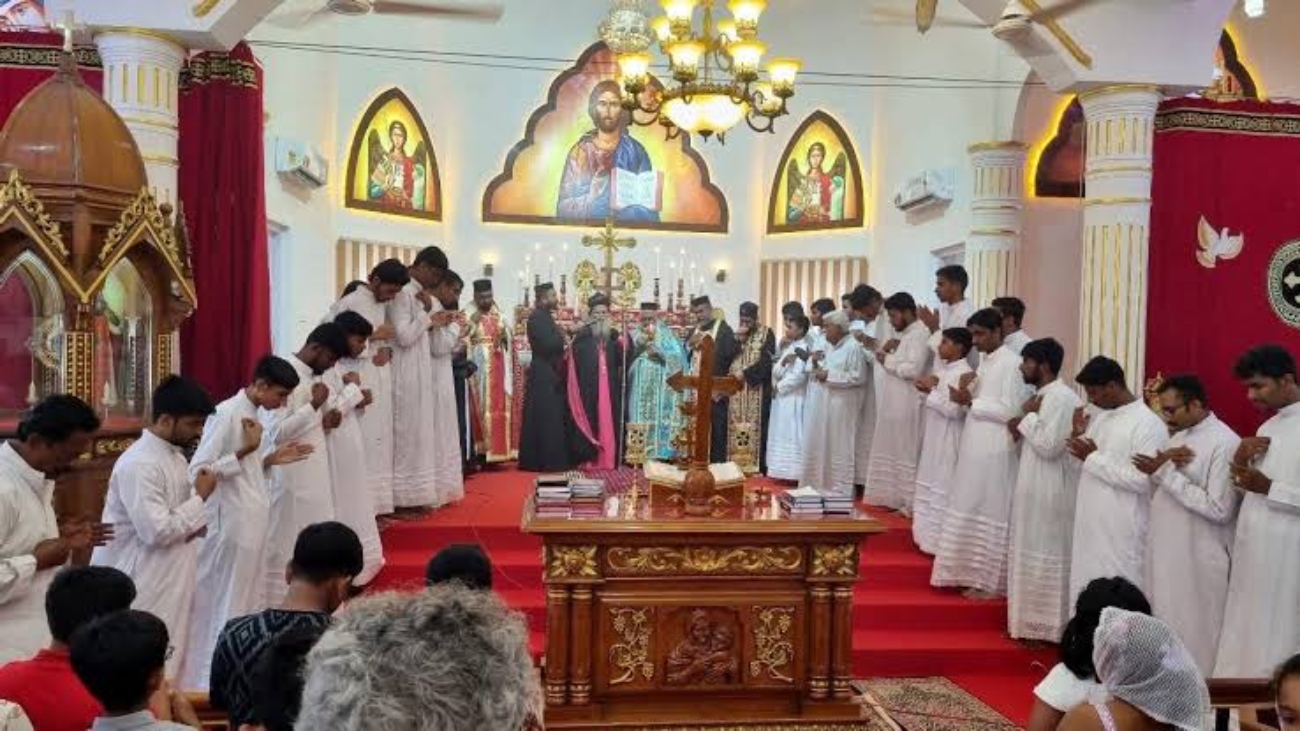
Kerala’s future competitiveness will depend not only on how many people it educates, but on what kind of thinkers and leaders its education system produces. By 2047, the state will face a paradoxical shortage: an abundance of degree holders alongside a scarcity of individuals capable of research, institutional leadership, and long-horizon civic thinking. Vision Kerala 2047 therefore demands an empowerment model that bridges education, research culture, and public leadership at an early stage. One Christian group whose historical role uniquely aligns with this requirement is the Mar Gregorios Orthodox Christian Student Movement.
The MGOCSM was founded in 1907, making it one of the oldest Christian student movements in India. Its emergence coincided with a period of intellectual ferment in Travancore, marked by social reform movements, the expansion of modern education, and debates on faith, reason, and public life. Unlike devotional youth groups focused primarily on worship, MGOCSM was conceived as a student intellectual movement. Its early activities included reading circles, debates, essay competitions, and public lectures, often engaging with philosophy, history, science, and theology in parallel.
This intellectual orientation had long-term consequences. Throughout the twentieth century, MGOCSM became a training ground for teachers, academics, doctors, administrators, and public intellectuals. Many prominent figures in Kerala’s higher education and healthcare sectors passed through its study circles during their formative years. The movement normalized habits that are rare even today: sustained reading, structured argumentation, public speaking, and ethical self-examination. These habits matter because they form the cognitive infrastructure of research and leadership.
Kerala’s current higher education challenge is not access but depth. According to national higher education statistics, Kerala has one of the highest gross enrolment ratios in India, yet its research output per capita remains modest compared to states with fewer students. Doctoral enrolments are growing, but citation impact and industry linkage lag behind. This gap is not purely a funding issue; it is cultural. Research requires patience, tolerance for ambiguity, and comfort with critique, traits that are not cultivated by exam-centric systems alone.
MGOCSM’s historical culture addresses precisely these gaps. From its inception, the movement emphasized questioning rather than memorization. Study classes were designed to provoke discussion, not deliver conclusions. This approach resonated with the Malankara Orthodox intellectual tradition, which historically engaged with Greek philosophy, Syriac scholarship, and later Western academic thought. By the early twentieth century, Orthodox seminaries and colleges were already producing graduates comfortable navigating multiple knowledge systems.
Vision Kerala 2047 must leverage this intellectual legacy to rebuild a research-oriented mindset at scale. Student empowerment here should be understood as the ability to think independently, contribute to knowledge creation, and assume responsibility in public institutions. MGOCSM’s structure, with units in colleges across Kerala and beyond, provides a ready-made network for such empowerment.
Historically, MGOCSM units functioned as parallel classrooms. Students discussed social issues such as caste discrimination, education reform, and national independence well before these topics entered mainstream curricula. During the pre-independence period, MGOCSM members participated in debates on self-rule and social justice, often mediating between tradition and reform. This capacity to engage contemporary issues intellectually without succumbing to ideological rigidity is particularly relevant in an era of polarized discourse.
By 2047, Kerala will require leaders who can operate across domains: technology, policy, ethics, and community engagement. Traditional student politics has often emphasized mobilization over analysis, producing leaders skilled in agitation but not institution-building. Research empowerment through movements like MGOCSM offers an alternative leadership pipeline, one rooted in reflection, evidence, and long-term responsibility.
One critical area is interdisciplinary thinking. Kerala’s policy challenges, from aging populations to climate adaptation, cannot be solved within single disciplines. MGOCSM’s tradition of integrating theology, science, history, and social thought encourages intellectual synthesis. Reviving and modernizing this approach can support the development of interdisciplinary research clusters among students, particularly in areas like public health, environmental studies, and social policy.
Another dimension is ethical grounding. Research and leadership without ethics risk becoming extractive or technocratic. The Orthodox tradition emphasizes moral accountability and service, framing knowledge as a responsibility rather than a commodity. In a future where AI, biotechnology, and surveillance technologies will raise complex ethical questions, leaders trained to think morally as well as analytically will be invaluable. MGOCSM’s long-standing emphasis on ethics alongside intellect positions it well for this role.
The history of Kerala’s higher education shows the importance of student-led intellectual culture. In the 1950s and 1960s, reading rooms, literary societies, and student journals played a key role in shaping public discourse. Many of these spaces have since declined under exam pressure and digital distraction. MGOCSM historically sustained such spaces even when institutional support was limited. Reinvesting in student-led journals, lecture series, and research clubs within this network can revive a culture of intellectual seriousness.
Research empowerment must also address global engagement. Kerala’s academic diaspora is substantial, yet institutional links remain weak. MGOCSM’s alumni network spans universities and research institutions worldwide. Historically, informal mentorship and correspondence connected students in Kerala with scholars abroad. Formalizing these connections into structured mentorship, visiting lecture programs, and collaborative research initiatives can globalize Kerala’s student research culture without encouraging permanent brain drain.
Importantly, this vision is not about privileging a religious identity. MGOCSM units have historically operated in plural campuses, engaging students across faiths and backgrounds. The movement’s credibility comes from its intellectual seriousness rather than exclusivity. Maintaining this openness is essential for relevance in a diverse society.
By 2047, Kerala’s progress will depend on whether it can produce thinkers who understand complexity, tolerate uncertainty, and commit to public responsibility. Research and leadership empowerment cannot be delivered solely through policy mandates or funding schemes. They require cultural scaffolding, sustained over generations.
The Mar Gregorios Orthodox Christian Student Movement represents such scaffolding. With over a century of experience in cultivating student intellect and ethical leadership, it offers a historically grounded pathway for empowering the next generation of researchers and public leaders.
