
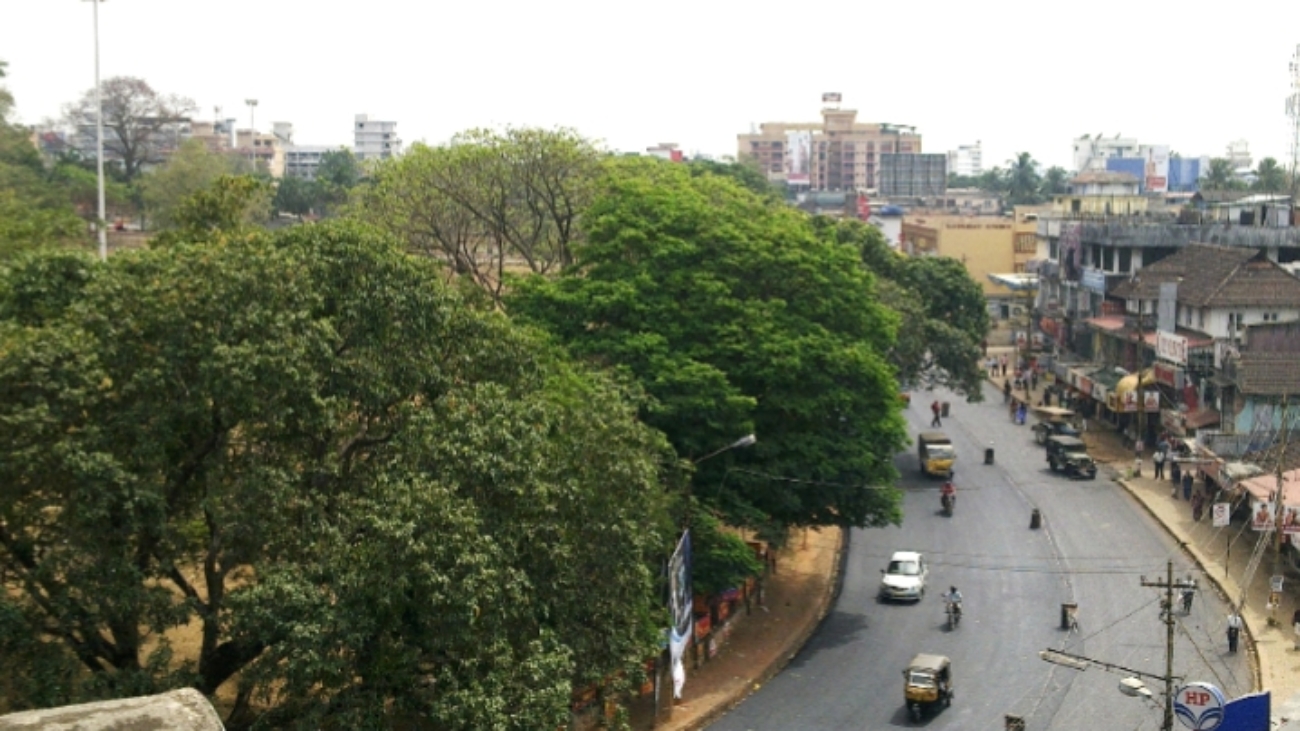
Thrissur’s smart city future must be built around coordination rather than expansion. The city is not constrained by lack of land or institutions, but by poor synchronization between them. Roads, schools, temples, markets, hospitals, banks, and cultural venues coexist densely, yet function as parallel worlds. A smart Thrissur in 2047 must become a city where systems move in rhythm rather than collide by accident.
The defining spatial feature of Thrissur is its circular structure around the Round and the Vadakkunnathan Temple. This natural geometry should become the organizing logic of the city. Instead of treating the Round as a congestion problem, smart planning must treat it as a coordination core. Traffic, pedestrian movement, public events, and commerce must be timed and layered intelligently so the city breathes rather than chokes around its center.
Mobility in Thrissur must focus on decongestion through timing rather than widening. Office hours, school timings, market operations, and institutional schedules currently overlap unnecessarily, creating artificial peaks. A smart city approach would stagger time rather than endlessly expand roads. When institutions cooperate on schedules, traffic reduces without new construction. Time management becomes infrastructure.
Thrissur’s economy is unusually diversified for a mid-sized city. Banking, gold trade, education, healthcare, culture, and small manufacturing coexist. Smart city planning must strengthen interconnections between these sectors instead of treating them independently. Financial institutions can support local enterprises more directly. Educational institutions can align skills with city-based economic needs. Cultural events can be leveraged as structured economic cycles rather than seasonal chaos.
Cultural density is Thrissur’s greatest strength and greatest vulnerability. Festivals like Pooram generate massive footfall and emotion, but also stress infrastructure. A smart Thrissur must treat culture as a predictable system rather than an exception. Crowd flow, transport, emergency services, sanitation, and commerce during festivals must be simulated, planned, and optimized every year. When culture is supported intelligently, it scales without damage.
Public spaces in Thrissur require redefinition. The city has gathering spaces, but few designed for everyday quiet use. Smart cities must balance celebration with restoration. Libraries, shaded walking loops, calm parks, and senior-friendly public areas must exist alongside loud and vibrant zones. Mental balance in a city comes from spatial balance.
Water management in Thrissur demands anticipatory planning. Urban flooding here is often localized but disruptive. Smart systems must map drainage, soil absorption, and construction impact at the street level. New buildings must be accountable not only for their footprint, but for how they alter water flow around them. When each construction decision respects the city’s hydrology, cumulative damage reduces.
Housing in Thrissur must remain inclusive. Rising land values around key areas risk pushing working populations outward. A smart city must ensure that service workers, teachers, nurses, artisans, and traders can live within the city they sustain. Mixed-income housing and rental stability are essential to prevent social hollowing. Cities collapse quietly when the workforce is pushed away.
Education must be integrated with city life. Thrissur hosts many educational institutions, yet students often remain disconnected from the city’s economic and cultural systems. Smart Thrissur must blur the boundary between campus and city. Internships, apprenticeships, civic projects, and cultural participation must be embedded into urban systems. When students see the city as opportunity rather than transit, talent retention improves.
Healthcare planning must move beyond hospital capacity. Thrissur already functions as a regional medical hub. Smart city thinking must focus on prevention, accessibility, and continuity. Walkable neighborhoods, reduced noise, predictable mobility, and accessible clinics reduce pressure on tertiary hospitals. Health outcomes improve when the city itself becomes therapeutic.
Governance in Thrissur must prioritize clarity. Citizens should be able to understand why decisions are taken, how money is spent, and what outcomes are expected. A transparent project-tracking system reduces rumor, suspicion, and political noise. When governance becomes legible, civic cooperation increases naturally.
Digital systems in Thrissur must respect its human scale. The city does not need overwhelming automation. It needs quiet efficiency. Services must work reliably, interfaces must be simple, and escalation paths must be clear. Smartness here lies in reducing friction, not showcasing complexity.
Economic resilience in Thrissur depends on protecting its small enterprises. Gold traders, artisans, teachers, healthcare workers, event-related businesses, and service providers form a dense economic web. Smart policies must ensure these actors are not displaced by large, extractive developments. Stability is an economic asset.
Thrissur’s religious diversity has historically enabled coexistence rather than conflict. Smart city planning must preserve this balance by ensuring equal access, neutral infrastructure, and respectful regulation of shared spaces. Cities fracture when one group feels spatially or administratively marginalized.
By 2047, a smart Thrissur should feel coordinated rather than hurried. Its intelligence should be visible in how smoothly events unfold, how calmly people move, and how predictably systems respond. The city should not feel louder or faster, but more in control of itself.
